As rail transit continues its shift toward digitalization, intelligence, and high-end engineering, critical assets—vehicle design, signaling control algorithms, traction and braking parameters, structural simulation models, and commissioning/testing data—have become the most important digital data across the full lifecycle: design, integration, simulation validation, manufacturing, commissioning/delivery, and operations & maintenance.
These assets represent long-term R&D investment and directly affect system safety, reliability, and stability. A single leak can cause irreversible IP loss, enable counterfeiting, weaken competitiveness, and introduce safety risks that may impact public safety and critical infrastructure. Meanwhile, regulations and supervision are tightening; any data security incident can lead to penalties, qualification constraints, bidding barriers, and reputational damage.
Key Data Security Issues in the Industry
-
Core technical data is extremely valuable—leaks are irreversible
-
Frequent multi-project, multi-party collaboration—complex flows amplify risk
-
Long project cycles and high personnel mobility—historical data becomes uncontrolled
-
On-site commissioning and remote O&M—data leaves perimeter defenses
-
Stronger compliance requirements—classification, access control, auditing, and traceability are mandatory
Solution (Ping32)
With transparent encryption at the core, combined with security domain isolation + controlled sharing + offline protection + decryption gateway + sensitive content analysis, Ping32 makes critical data usable, controllable, auditable, and traceable throughout its lifecycle.
1) File Encryption: The First Line of Defense for Engineering Data
Ping32 uses driver-level transparent encryption to perform real-time encryption/decryption at the OS layer. Files are automatically encrypted when created, saved, or modified. They work normally within authorized corporate environments; once copied to unauthorized endpoints or external environments, they become unreadable—technically enforcing “usable but not leakable.”
This mechanism covers R&D, manufacturing, and O&M endpoints, supporting 200+ file formats including CAD drawings, simulation models, algorithm/source code, parameter tables, and test data.
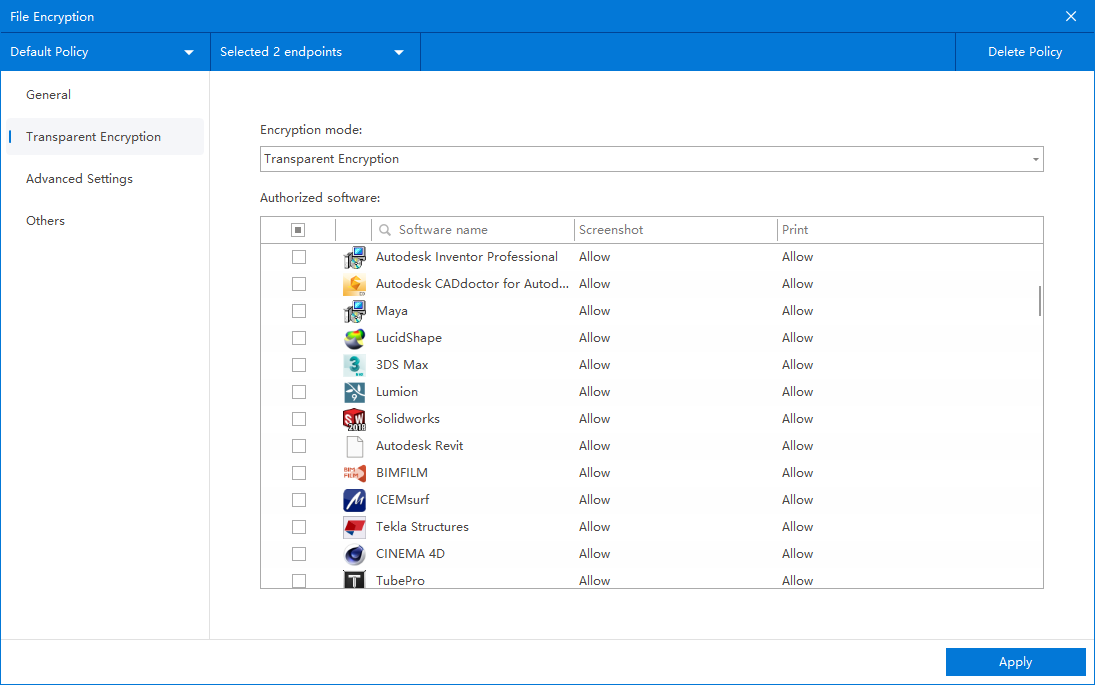
1.1 Unified Encryption: Cover core R&D, production, and O&M data
Based on data classification, Ping32 applies unified encryption to:
-
R&D: design drawings, algorithms, parameter models
-
Production: process documents, assembly instructions
-
O&M: commissioning records, fault analysis reports
Files remain encrypted when copied, forwarded, or taken outside controlled environments, preventing unauthorized access and misuse.
1.2 Security Domain Isolation: Build department- and project-level boundaries
Ping32 supports security domains by department, project, or role to achieve logical isolation and graded visibility. Domains are isolated by default; cross-domain access requires approval, reducing leakage risks from excessive privileges or mistakes.
1.3 Controlled External Sharing: Enable collaboration without losing control
To support design collaboration, reviews, project alignment, and delivery workflows:
-
Plain sharing: requires an approval workflow; decryption actions and timing are fully logged for audit and accountability.
-
Cipher sharing: recipients must pass authentication to access; only online viewing or controlled opening is allowed; saving, editing, and redistribution are restricted. Access validity period, view counts, and permission scope can be configured; permissions automatically expire and are reclaimed after collaboration.
2) Flexible Approvals: Balance Efficiency and Compliance
-
Mobile approvals: handle sharing requests anywhere to avoid delays
-
Console approvals: centralized review and auditing for security/admin teams
-
Third-party integration: integrate with enterprise collaboration and OA systems to embed approvals into existing workflows and avoid management silos
3) Offline Protection: Secure Field Commissioning & Travel Scenarios
For on-site commissioning, remote delivery, and train line testing, Ping32 supports offline authorization with time validity. Temporary permissions expire automatically. Even if a device is lost, encrypted files remain unreadable—mitigating physical loss and endpoint compromise risks.
4) Decryption Gateway: Keep Business Systems Continuously Available
For PLM, PDM, OA, and project management systems that cannot directly handle encrypted files, Ping32 provides a decryption gateway. During file upload, encrypted files are decrypted in a controlled manner so systems can preview, approve, and archive normally—while endpoints and original data remain encrypted.
5) Sensitive Content Analysis + Encryption: Automatic Identification & Precise Protection
Ping32 links sensitive content analysis with encryption policies. Using keyword rules and regular expressions, it automatically identifies and classifies technical and internal data, triggering encryption and access controls during creation, saving, sharing, and circulation—reducing human errors and gaps.
FAQ
Q1: Will transparent encryption affect engineers’ daily workflow?
A: No. In authorized environments, users work as usual; encryption/decryption runs automatically at the OS layer.
Q2: What file types are supported?
A: CAD drawings, simulation models, source/algorithm code, parameter tables, testing/commissioning data, documents/spreadsheets—200+ formats.
Q3: How do you prevent cross-project data mix-ups or accidental sharing?
A: Security domains isolate data by department/project/role; cross-domain access requires approval and is fully audited.
Q4: How can we share files with suppliers or contractors without losing control?
A: Use approved plain sharing with full logs, or cipher sharing with controlled viewing, restrictions, and configurable expiry/quotas.
Q5: What about offline use and device loss?
A: Offline permissions are time-bound and expire automatically; lost devices cannot decrypt protected files.
Q6: Our PLM/PDM/OA can’t recognize encrypted files—what should we do?
A: Use the decryption gateway to enable preview/approval/archiving while keeping endpoints and original data encrypted.





 Contact


 6 min
6 min