The two-day Cyber Security World Asia 2025 successfully concluded on October 9 at Marina Bay Sands Expo, Singapore. As one of Asia’s key cybersecurity events, this year’s show brought together security technology vendors, solution providers, and industry practitioners from around the world. Participants engaged in broad exchanges and in-depth discussions on major topics such as data security, endpoint protection, compliance governance, and security challenges in the AI era. The exhibition floor was vibrant, with product launches and case-study sharing taking place throughout—offering valuable insights for enterprises advancing their digital security capabilities across the region.
NSecsoft participated in the event with its core products and solutions—including Ping32 and FileLink—highlighting its capabilities and proven implementation experience in endpoint security and data protection. Through live demonstrations, solution briefings, and interactive discussions, the NSecsoft team presented an end-to-end approach spanning endpoint protection, full data lifecycle governance, and compliance auditing, further underscoring the maturity of its enterprise security offerings and the responsiveness of its services.
Highlights Recap
During the exhibition, the NSecsoft booth welcomed professional visitors from industries such as advanced manufacturing, finance, government, and public services. Based on both common requirements and industry-specific scenarios in security programs, NSecsoft engaged in in-depth conversations with attendees around endpoint protection capabilities, deployment adaptability, policy management, operational efficiency, and localized support mechanisms. Many visitors—drawing on their own business environments—paid particular attention to: policy tiering and permission models in complex organizational structures, data boundary control across cross-department collaboration, and integration with existing IT management systems. Using typical business scenarios as entry points, the NSecsoft team further broke down implementation paths and operational requirements, enabling customers to more clearly understand critical steps and practical considerations in real-world deployments.
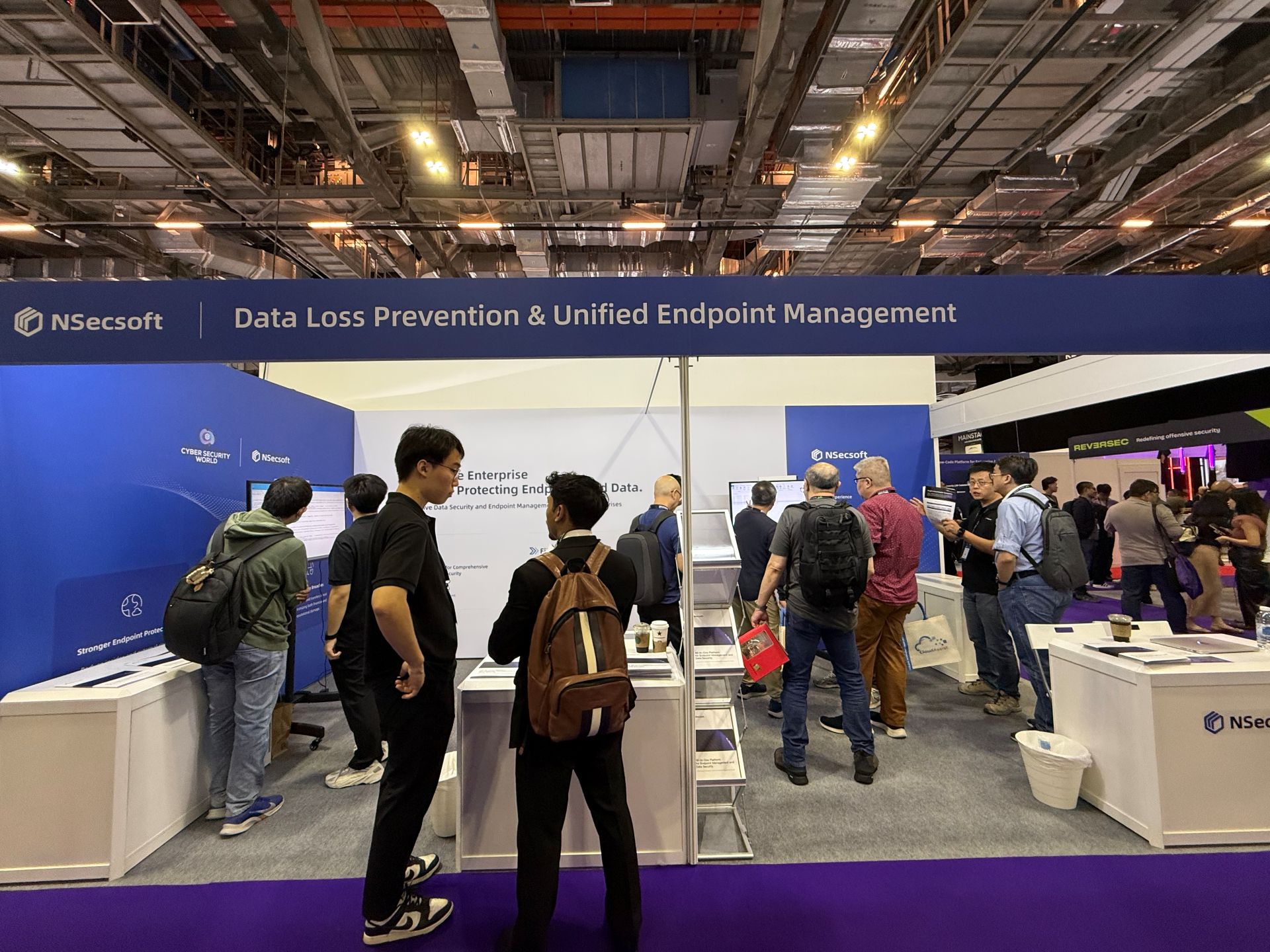
In these discussions, many visitors noted that rapid growth in endpoint scale, frequent changes in roles and permissions, and “multi-location, multi-network, multi-endpoint” work environments make traditional approaches—relying on manual approvals or static policies—difficult to sustain over time. As a result, platform capabilities that are automated, auditable, and configurable at a fine-grained level are increasingly becoming key evaluation criteria when selecting security solutions. In response, NSecsoft shared practical experience on improving security management efficiency and reducing operational overhead through policy templates, tiered authorization, and a unified audit trail.
Among the showcased offerings, the Ping32 integrated endpoint and data security platform attracted significant attention due to its high level of integration and synergy across capabilities including data loss prevention (DLP), transparent document encryption, endpoint security management, and software compliance management. With a focus on the core enterprise objective of ensuring data flows are “controllable, visible, and traceable,” the team introduced key technical features and usage approaches:
-
Transparent Encryption: Files are automatically encrypted during creation, editing, and storage with minimal disruption to user workflows. When files leave the authorized environment or are taken outside controlled boundaries, access and usage are restricted based on policy—reducing the risk of sensitive data spreading at the source.
-
Sensitive Content Identification: Combining rule-based capabilities with model-based techniques, the platform identifies and classifies sensitive information and provides risk alerts. It can warn or block high-risk actions such as external sending, copying, or uploading before they occur, helping organizations reduce compliance exposure caused by accidental operations.
-
Centralized Policy Management: Supports flexible security policy configuration by department, role, and business scenario, with unified policy distribution and auditing. This enables “tiered authorization with unified governance,” while providing security administrators with a clearer policy closed-loop and audit trail.
-
Cross-Regional Collaboration Support: Provides a multilingual interface and cross-network policy synchronization to balance compliance governance and collaboration efficiency for cross-regional organizations—helping global or regional enterprises build more consistent security management systems.
To help visitors better understand how platform capabilities translate into real business actions, the team also explained typical scenarios. For example, in R&D and manufacturing, data flows involving design drawings, process documents, and supplier collaboration materials often require stronger controls such as “controlled external sharing, revocable permissions, and traceable actions.” Financial institutions tend to focus on sensitive information identification and the completeness of audit trails. Public service organizations place greater emphasis on compliant deployment models, localized support, and replicable policy governance. By breaking down needs and solution paths from an industry perspective, conversations became more targeted and helped stakeholders form a clearer consensus on platform value.
In addition to Ping32, NSecsoft also showcased the FileLink cross-network file exchange system. Addressing the common need for internal/external data transfer in sectors such as research and manufacturing, FileLink supports secure and controllable file transmission and exchange in segregated network environments, with comprehensive audit controls. It enables end-to-end logging, permission control, and traceable review—strengthening security boundaries while maintaining collaboration efficiency, and providing a robust technical and management foundation for cross-network and cross-region collaboration.
In many real-world environments, segregated networks have long posed collaboration efficiency challenges: business teams need to exchange files while still meeting stringent approval, auditing, and compliance requirements. Discussions at the booth focused on common risk points and governance strategies in file exchange processes, including source authenticity validation, transmission security, traceable approval workflows, post-transfer audit trails, and anomaly alerts. FileLink’s “process-driven + audit-driven” approach also offered a practical reference for cross-network collaboration governance across industries.
To address questions from different sectors, NSecsoft’s cross-functional team collaborated on-site to provide detailed explanations and interactive Q&A around core functions, compatibility and adaptation, deployment options, operations management, and compliance auditing. Notably, discussions extended beyond “product capabilities” to include “delivery methodology,” such as policy mapping and tiering, pilot scope selection, rollout pace and training mechanisms, and ongoing operations and audit readiness after go-live. These project-oriented conversations further strengthened visitors’ confidence in the solution’s deployability and long-term sustainability.
Through this event, NSecsoft expanded its pool of potential customers across Southeast Asia and gained deeper understanding of real local needs and key scenarios in cybersecurity, data protection, and compliance governance. Meanwhile, feedback gathered on-site will support future regional product optimization, refinement of delivery methodologies, and enhancement of service strategies—helping NSecsoft serve the regional market in a more practical and sustainable manner.
Based on observations of the regional market, NSecsoft will continue to strengthen localized capabilities, including compliance policy alignment with local regulations and industry standards, improved collaboration experiences for multilingual and multi-region organizations, and a higher-efficiency support system. With a dual engine of “product capabilities + service体系,” the company aims to build a stronger delivery reputation and long-term value in Southeast Asia.
Partnership Discussions · Deepening the
Southeast Asia Market
During the exhibition, NSecsoft held in-depth discussions with multiple local partners and customers from Singapore and across Southeast Asia. Focusing on data security compliance, localized deployment needs, industry scenario alignment, and joint solution delivery, both sides clarified future cooperation directions and execution paths. Leveraging local partners’ strengths in industry resources, customer services, and scenario understanding, NSecsoft will continue to build its regional service system and gradually improve end-to-end support across pre-sales consulting, project delivery, and ongoing operations—providing customers with security products and technical support that are closer to business needs and more responsive.

Regarding the cooperation approach, both sides also discussed more actionable delivery methods—for example: building replicable benchmark cases in key industries first, then scaling through joint marketing and customer success mechanisms; forming standardized delivery packages at the deployment level to shorten time-to-go-live; and establishing coordinated response mechanisms at the service level to improve support efficiency for local customers. These shared understandings provide clearer handles for follow-up collaboration.
“We hope to enter the regional market with a more open and innovative mindset, and make Ping32 the preferred platform for digital security across Southeast Asia.”
— Head of Overseas Business, NSecsoft
Industry Exchange · Shaping the
Future of Security
After the exhibition, as a VIP exhibitor, NSecsoft was invited to a closed-door networking dinner organized by the event host. The company held in-depth discussions with global cybersecurity experts, industry leaders, and technology partners on data security governance, cross-border compliance challenges, and emerging security trends in the AI era. Through high-quality dialogue, NSecsoft shared practical experience and project insights, further strengthening consensus with international peers and injecting new momentum into future multi-level, multi-domain collaboration.
Around AI-era security topics, participants widely agreed that while AI improves automation and efficiency, it also introduces new challenges such as data usage boundaries, governance of training data for models, and compliance risks related to generated content. Enterprises, therefore, urgently need to continuously build foundational capabilities in data governance, endpoint controls, and auditing systems to remain in control and compliant amid new technology waves. NSecsoft also shared its perspective on “platformization, integration, and auditability,” emphasizing the importance of unified policies and traceability in providing organizations with a more resilient security governance path.
Looking Forward to Seeing You Again!
Although this event has concluded, NSecsoft’s pursuit of cybersecurity innovation and service excellence will continue. We will remain focused on intelligent and security-driven technological advancements, refining product and solution capabilities across endpoint security, data governance, and compliance auditing—helping enterprise customers build more efficient and trustworthy security solutions and move forward steadily in their digital transformation journey.
Sincere thanks to everyone who visited our booth, and to our partners and industry peers for your attention and support.





 Contact


 11 min