




 Contact


 12 min
In the smart robotics manufacturing industry, digital assets—R&D drawings, control algorithms, source code, structural BOMs, test data, and customer-specific solutions—flow across the entire lifecycle, from development and prototyping to mass production and delivery. As collaboration chains lengthen and work styles diversify, data egress and behavior-driven risks become more hidden. Traditional perimeter-focused security often fails to cover the most critical paths that occur on endpoints and through employee actions.
Ping32 addresses smart robot manufacturing scenarios with a solution built around endpoint identity governance, behavior auditing with evidence trails, risk detection and alerting, and closed-loop policy operations. This enables organizations to progressively achieve asset visibility, risk controllability, and compliance traceability—while minimizing impact on business efficiency.
1. Industry Background: Changes Smart Robot Manufacturers Are Experiencing
As industrial digital transformation accelerates, smart robotics manufacturing has become a clear example of advanced manufacturing converging with AI. Whether industrial robots, collaborative robots, or specialized robots for logistics, healthcare, and warehousing, products integrate substantial software/hardware technology, sensing algorithms, motion-control logic, and domain know-how models. These capabilities form core competitiveness while also carrying significant trade secrets and intellectual property.
At the same time, competition is intensifying. Collaboration across brand owners, solution providers, contract manufacturers, and upstream/downstream supply chains is increasingly frequent. Business scope is expanding from traditional manufacturing into software platforms, data collection, remote operations, and industry solutions. As boundaries expand, the exposure surface of information assets expands too. As a result, data security is shifting from “Is the network secure?” to “Are data controllable and behaviors traceable?”—a more comprehensive governance capability.
Smart robot manufacturers commonly face three pressures:
-
Rising security and compliance requirements from customers and partners
Supply-chain security assessments are becoming stricter, with clear expectations for document access control, source code governance, technical information confidentiality, data egress control, and audit evidence. -
Growing internal complexity as organizations scale
R&D, testing, manufacturing, sales, service, and outsourced teams spread across multiple locations. Systems and work methods become more diverse, reducing visibility into information flows and increasing risk points. -
Business and reputational risk from leakage of critical data
Leaks of design drawings, control-algorithm source code, structural BOMs, test reports, or customer proposals can cause direct losses and long-term damage to credibility, partnerships, and strategic direction.
Therefore, manufacturers urgently need an endpoint data and behavior governance system that protects information without materially impacting productivity, and that can progressively align with compliance requirements.
2. Typical Situation & Pain Points: Endpoint and Behavior Governance as the Core Gap
During a security review, a smart robot manufacturer found that even with traditional perimeter security, multiple risks remained: engineers took files offsite for debugging; technicians exchanged materials with contract factories via personal email; employees forwarded sensitive files in chat tools; and some staff pasted unreleased design details directly into AI tools.
Leadership realized the core issue was not “whether the network is secure,” but whether endpoints and employee behaviors are effectively governed. The organization decided to evaluate endpoint-focused data security and behavior management solutions, adding Ping32 to the shortlist.
The company had already deployed foundational systems like ERP and PLM and was moving R&D collaboration onto online platforms. However, as the business grew, four pain points became clear:
(1) R&D materials are scattered; sensitive documents lack unified management
R&D teams use Git repositories, shared drives for mechanical drawings and design documents, and instant messaging to exchange materials with suppliers. Without unified data classification and access boundaries, accidental or malicious exfiltration can go unnoticed and is difficult to trace back.
(2) Frequent external collaboration; data egress lacks controllability and traceability
Robotics manufacturing often involves outsourcing and prototyping, requiring phased sharing of critical technical documents. In practice, organizations struggle to answer:
-
Which files are allowed to be sent out?
-
Sent to whom, and within what scope?
-
Should they be encrypted or watermarked?
-
Can external recipients only view, without copying or redistributing?
Without fine-grained controls, protection relies on “employee awareness” and “contract terms,” which is insufficient.
(3) Limited visibility into endpoint usage
Even if company-issued PCs are deployed, it’s often unclear whether employees install unauthorized software, frequently connect USB devices, or take materials home. Without continuous auditing and evidence trails, anomalies may only be discovered after losses occur.
(4) Slow incident response and weak prevention for pre-exit risks
A past incident involved an engineer copying large volumes of work materials to a portable drive before leaving, including documents for an unreleased control-logic version. Even if legal action reduces losses afterward, it exposes governance gaps and reinforces the need for system-level prevention.
Based on these realities, the organization set a goal to build an integrated capability of “asset visibility, controllable risk, and auditable compliance,” with four concrete requirements:
-
Make endpoint behaviors visible and explainable through auditable evidence
-
Apply reasonable controls on top of transparency, avoiding one-size-fits-all blocking
-
Provide real-time alerts for high-risk scenarios to enable timely intervention
-
Ensure stability, easy-to-understand policies, and minimal disruption to business workflows
3. Solution Design: From Audit Evidence to Standardized Control, Rolled Out in Layers
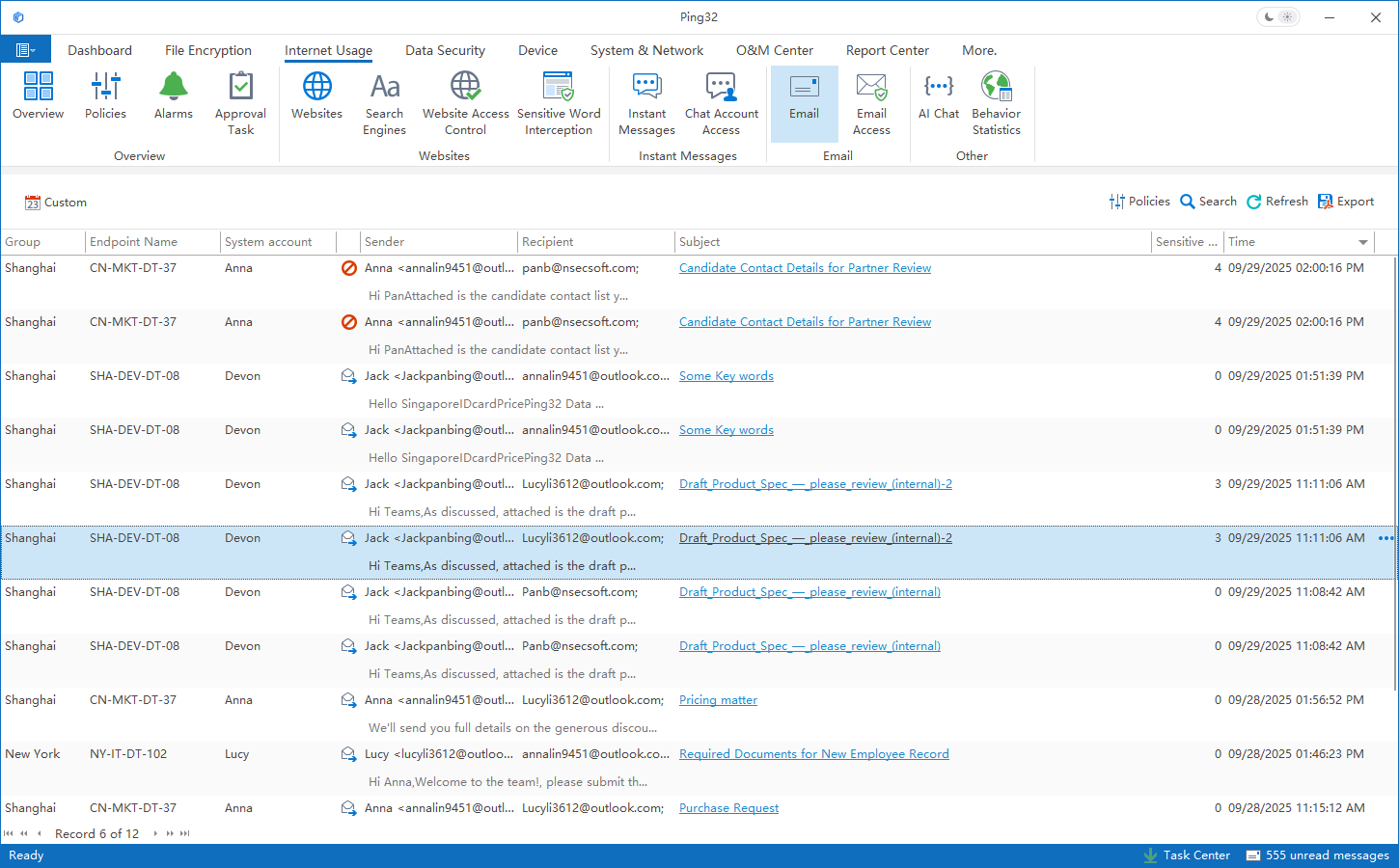
The solution focuses on seven key capabilities: login security configuration, admin privilege management, alert notifications, web access auditing, web access control, sensitive keyword evidence logging, and email auditing. Together, these cover endpoint identity governance, behavior visibility, risk judgment, and violation response—forming the foundation for endpoint security governance.
Depending on maturity, deployment typically follows three approaches:
Approach 1: Lightweight Auditing (establish a baseline first)
Centered on web access auditing, sensitive keyword logging, and email auditing, this approach helps organizations understand real-world browsing and data egress patterns. Alerts are used to flag obvious anomalies without heavy intervention. It’s quick to implement and low-friction, ideal for building early risk awareness. The limitation is that it is more post-event oriented and can be reactive against deliberate exfiltration.
Approach 2: Standardized Governance (balance auditing and control)
This is the recommended strategy for most organizations. It retains auditing while introducing institutional controls at key points:
-
Use web access control to set role-based access scopes by department
-
Use login security to bind endpoints to user identities and reduce account sharing
-
Use admin privilege management to implement tiered, domain-based permissions and avoid over-centralization
-
Use alert notifications to close the loop and improve response speed
Employees can feel the presence of governance without experiencing blunt restrictions. This approach balances security and efficiency.
Approach 3: High-Pressure Control (strong restriction, strong enforcement, strong auditing)
This approach resembles highly regulated environments: default blocking of external sites, mandatory approvals for all data egress, blocking on sensitive keyword detection, etc. While it can maximize security, it may significantly impact R&D and collaboration. As a result, it’s best applied to a small set of critical roles rather than organization-wide.
4. Implementation: Governance-First, With Stronger Controls for Critical Roles
After discussion and tradeoffs, the organization adopted a hybrid model: “standardized governance as the baseline, stronger controls for critical roles.”
-
Start with identity governance: Each endpoint login is bound to a specific person; sensitive roles use stricter login policies.
-
Department-differentiated web policies:
-
R&D can access necessary technical forums and documentation resources but has restrictions on suspicious cloud drives and high-risk links
-
Sales can access customer platforms and industry information
-
Production endpoints are limited to essential business systems to reduce exposure
-
-
Risk identification and audit tracing for data egress:
Using sensitive keyword logging and email auditing, the system flags potential outbound materials involving technology, pricing, or agreements and creates traceable records. Bulk sending within a short period triggers higher-severity alerts to notify responsible owners for evaluation and action.
This approach avoids blocking legitimate work while providing a clear audit trail and faster risk response.
5. Outcomes: From Fragmented Controls to Systematic Capability
After three months in production, evaluation showed a clear decrease in high-risk data egress behavior. Multiple potential incidents were discovered early and stopped. IT teams reported that investigations that used to take hours or days now take minutes to pinpoint the specific endpoint, employee, and operation path—significantly improving traceability efficiency.
More importantly, employee behavior began to change. When sending files or using external tools, people naturally consider compliance boundaries, shifting from passive management to proactive self-discipline.
In subsequent supplier security assessments, the endpoint governance system became a key supporting pillar. Reviewers valued not just auditing, but also the alert mechanism and closed-loop policy operations, concluding the organization had a more complete data protection capability. In practice, security becomes not only prevention, but a way to strengthen customer trust.
6. Continuous Evolution: Preparing for AI and Expanding Collaboration Scenarios
Endpoint security governance is not a one-time purchase; it’s an ongoing program. As AI tools, mobile work, and outsourced collaboration expand, endpoint scenarios and data flow paths keep evolving. The next phase can focus on AI conversation security, mobile device access governance, data classification and tiering, unified visibility dashboards, and cross-system response orchestration—so security becomes a foundation for sustainable innovation rather than a constraint.
FAQ
1) Why isn’t perimeter-only security enough?
Data risks often occur on endpoints through user actions: file sending, email, chat forwarding, USB copying, and pasting into AI tools. These paths may bypass traditional perimeter control points, so endpoint identity, auditing evidence, and policy enforcement are essential.
2) What does “endpoint auditing” typically cover?
Common areas include web access auditing, email auditing, and sensitive keyword evidence logging. When combined with login controls, privilege management, and alerts, it forms a complete loop of visibility, traceability, and response.
3) How can you protect data without significantly hurting R&D efficiency?
Use role- and scenario-based policies: allow necessary technical resources for R&D while restricting high-risk paths; limit production endpoints to essential systems; keep customer/industry access for sales. Auditing plus alerts helps enforce governance without blunt blocking.
4) How does the solution support outsourced collaboration and data egress governance?
Based on audit trails, it identifies and alerts on anomalies such as unusual frequency, bulk sending in short periods, and emails/attachments containing sensitive keywords—improving early detection and traceability while establishing clear evidence chains.
5) Can it support customer security reviews and compliance audits?
Yes. Binding endpoints to users, maintaining audit evidence, alert mechanisms, and segregated privileges provides presentable and verifiable governance proof. Scope can be configured to match organizational requirements and applicable standards.


