As digital transformation continues to deepen across enterprises, data has become the core asset driving business growth. At the same time, data leakage risks are becoming increasingly complex and harder to detect. Traditional security defenses—such as Data Loss Prevention (DLP)—primarily focus on pre-incident policies and in-incident controls or blocking. However, as “Zero Trust” adoption accelerates and the attack surface keeps expanding, it is unrealistic to prevent every leakage incident. As a result, a critical question has emerged: after an incident occurs, how can an organization conduct fast, accurate, and complete traceback and evidence collection? This has become a key challenge for security operations and compliance audits.
Aggregated Search, proposed by Ping32, is an innovative capability framework designed specifically for the Incident Response phase. It goes beyond traditional log search by reshaping audit logic to transform scattered, heterogeneous audit data into a verifiable, reproducible event narrative. Starting from fragmented clues, organizations can quickly reconstruct the full picture of a leak and build a complete chain of evidence.
1) Starting with Incident Response Challenges: The “Signal-to-Noise” Dilemma in Massive Logs
In enterprise endpoint audit environments, a single device can generate hundreds of operational logs per day. Across an organization, daily audit data can accumulate to tens of millions—or even hundreds of millions—of records. When an incident occurs, the core challenge for security operations is often not “whether logs exist,” but the classic signal-to-noise dilemma: how to extract the key “signals” related to a leakage incident from massive, heterogeneous log data within a very short mean time to respond/resolve (MTTR).
Traditional audit traceback processes often require administrators to complete multiple tasks under intense time pressure, and each step can become a bottleneck. For example: time-scoping relies heavily on timestamps and manual cross-system comparisons; information identification depends on fuzzy matches using metadata like file names or email subjects; path reconstruction lacks automated correlation and requires manually stitching scattered logs together; and responsibility confirmation is difficult because evidence chains are prone to breaking—making it hard to produce materials that stand up to compliance or legal requirements. As data volume grows, log search based on relational databases or flat files rapidly declines in efficiency and accuracy, falling behind the modern incident response demand for speed, precision, and completeness.
2) Fundamental Limitations of Traditional Audit Approaches: Metadata Dependence and Performance Bottlenecks
The pain points of traditional audit solutions can be traced back to two structural issues: performance bottlenecks and insufficient forensic reliability.
2.1 Performance Bottlenecks: The Generational Shift from Relational Queries to Full-Text Indexing
Most traditional audit tools implement “search” by querying metadata fields in underlying databases—such as file name, path, recipient, subject, and similar attributes. This approach may be acceptable at small scale, but at tens of millions or hundreds of millions of records, query costs rise sharply and response times become difficult to guarantee.
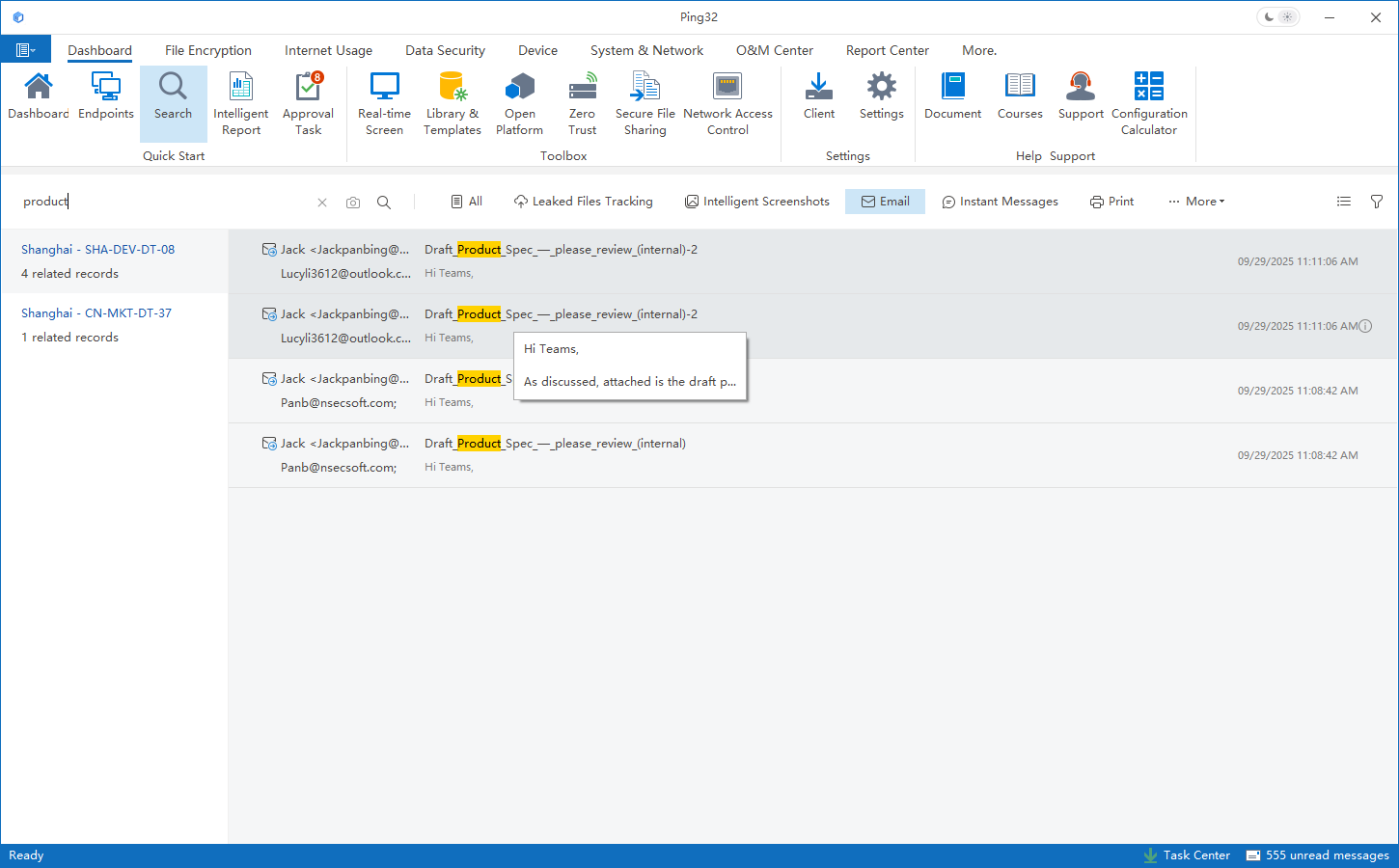
Ping32 Aggregated Search adopts a distributed full-text indexing architecture (for example, using an inverted-index approach similar to Elasticsearch). By pre-indexing the entire audit dataset, search shifts from “scan and filter” to “index hit,” enabling stable performance even at large scale and under high concurrency—an essential prerequisite for effective incident response.
2.2 Forensic Reliability: File Names Are Not a Trustworthy Basis for Traceability
A deeper issue is evidentiary reliability. Traditional approaches rely heavily on metadata such as file names, titles, and paths. In real-world leakage scenarios, however, metadata is inherently fragile and easy to manipulate:
-
File names can be arbitrarily changed or renamed.
-
Attackers can encrypt, compress, or change file extensions to evade metadata-based detection.
-
The same sensitive content may exist in multiple versions under different file names across multiple locations.
This means metadata-based auditing is often “probabilistic,” not “guaranteed traceable.” Once metadata is damaged or forged, the audit chain can break entirely, preventing complete traceback. For this reason, Ping32 positions metadata-based search as an initial triage capability, rather than the final goal of forensic investigation.
3) The Core Value of Aggregated Search: From Metadata to Deep Content-Level Matching
The key breakthrough of Aggregated Search is content awareness—shifting focus from “what a file is called” to “what the file actually is.”
3.1 Handling Fragmented Clues: Searching by “Content Fragments,” Not Just Files
In real leak investigations, administrators often cannot obtain the full source file. Instead, they have only fragmented clues, such as a snippet of sensitive business data, a specific phone number, an internal project codename, a short sentence from a document, or a fragment from a screenshot or PDF. These clues often cannot be mapped directly to log fields, and they are difficult to find using file names or other metadata.
3.2 How Content-Level Aggregated Search Works
Ping32 Aggregated Search enables deep content matching through three mechanisms:
-
Full-content indexing: During data collection, the system extracts text from file contents, email bodies, instant messaging (IM) messages, and other payloads, and builds a full-text index.
-
Post-incident, on-demand search: Administrators do not need to preconfigure complex regex rules or exact data matching policies. After an incident, they can simply input any fragmented clue.
-
High-speed matching and automatic aggregation: The system performs rapid matching across the global content index and automatically aggregates all cross-type behavioral records that contain the matched content.
With this approach, regardless of how sensitive content is named, formatted, or versioned, as long as it was recorded and indexed, it can be precisely located and traced.
4) Advanced Capabilities: Visual Intelligence and Correlation Analysis to Eliminate Audit Blind Spots
To achieve truly “no-blind-spot” auditing, text indexing alone is not enough. Aggregated Search further integrates visual intelligence and correlation analysis to cover more evasion scenarios.
4.1 Visual Intelligence: Deep Integration of OCR and Image-to-Image Search
In enterprise environments, a significant portion of sensitive information exists as unstructured data—scanned documents, images, PDFs, and screenshots. For traditional audit systems, these files are often unsearchable “black boxes.”
Ping32 integrates visual intelligence into the collection and indexing pipeline in two major ways:
-
OCR (Optical Character Recognition): Performs high-accuracy OCR on image and scan files, then adds the recognized text into the full-text index—enabling content-based search across images.
-
Image-to-Image Search: Uses image feature extraction and similarity matching. Administrators can upload a suspected leaked image as a clue, and the system will find visually similar images across the full audit dataset. This addresses scenarios where content is intentionally blurred, cropped, or re-encoded such that OCR cannot reliably extract text.
With this mechanism, even if a leaker attempts “screenshot exfiltration” or “print-scan” tactics, administrators can still trace the incident using text within images or the images’ own visual features—covering more data forms end to end.
4.2 Event Aggregation: Correlation Analysis Based on a Data Lineage Graph
The “aggregation” in Aggregated Search is fundamentally different from traditional “single-point search.” Traditional search returns isolated log records; aggregated search returns a complete event chain.
The system treats each operation (such as file creation, copying, compression, email sending, uploading) as a node in a graph, and treats data flow relationships as edges. Once a content search identifies an initial node, the system can automatically expand along predefined correlation models and connect heterogeneous behaviors across:
-
Channels: files, email, instant messaging (IM), cloud drive sync, external devices (USB).
-
Time: the full lifecycle from content creation to final exfiltration.
-
Entities: users, endpoints, content, and destination recipients/targets.
As a result, with a single search, administrators can obtain a “data flow map” that visually reconstructs the entire leakage incident—from the creation of sensitive data, through multiple transmissions, to final exfiltration—significantly improving both efficiency and evidentiary credibility.
5) Conclusion: Aggregated Search Defines a New Security Auditing Paradigm
Aggregated Search is not just “a faster search box.” It represents a shift in security auditing from passive, log-based retrieval to active, content-driven incident reconstruction.
It addresses three core pain points in enterprise security operations:
-
Efficiency: Full-text indexing ensures millisecond-to-second responses even at large scale, meeting real-time incident response requirements.
-
Accuracy: Deep content-level matching reduces reliance on easily manipulated metadata, enabling precise location even with fragmented clues.
-
Completeness: Visual intelligence and graph-based correlation remove blind spots in unstructured data and aggregate scattered behaviors into a complete event chain—supporting full-scope traceback and evidence closure.
When auditing no longer depends on probabilistic hits—and search results directly point to the full truth of an incident—an organization’s data leakage protection program can finally become controllable, trustworthy, and traceable.
FAQ (Aggregated Search and Security Audit Traceback)
1) What’s the biggest difference between Aggregated Search and traditional log search?
Traditional search is mostly field/metadata-based and often produces fragmented results. Aggregated Search is content-centric and automatically correlates dispersed audit data into an event chain, making it better suited for incident response and evidence building.
2) Is Aggregated Search the same as Elasticsearch?
No. Full-text indexing is an important technical foundation, but Aggregated Search is a broader capability set including content extraction, multi-source unified indexing, automatic aggregation/correlation, and event reconstruction through graph relationships.
3) Can I search using only a text snippet or a phone number?
Yes. If the element appears in collected and indexed payloads (file content, email body, IM messages, etc.), Aggregated Search can match it and aggregate related behaviors to reconstruct the data flow path.
4) Can it still trace data after renaming, compression, encryption, or file extension changes?
Renaming and extension changes typically do not affect content-based matching. Compressed files can be indexed where content can be extracted. For encrypted files that cannot be decrypted for content extraction, the system can still reconstruct incidents using exfiltration behaviors, file characteristics, and upstream/downstream correlations—depending on the collection and parsing scope.
5) Can it find sensitive information in images, scans, PDFs, or screenshots?
Yes. OCR makes image text searchable by indexing recognized text, and image-to-image search can retrieve similar images even when content has been cropped, blurred, or re-encoded.
6) What exfiltration channels can be correlated into a complete incident?
Commonly: file operations, email, IM, cloud drive sync, and external devices (USB). Aggregated Search can also correlate time sequence and entities (user/endpoint/recipient) to generate a data flow map.
7) Which teams or scenarios is this best for?
SOC/security operations, internal audit and compliance, and data security/DLP teams—especially for leak investigations, compliance evidence, major incident postmortems, and cross-channel traceback.





 Contact


 11 min