As digital transformation and hybrid work become deeply intertwined, the lifecycle of enterprise data is being structurally reshaped. The traditional, data-center-centric centralized storage model is evolving into a distributed usage model anchored on employee endpoints. Business data no longer resides solely in controlled business systems or file servers; instead, it is widely dispersed across endpoint devices and is frequently edited, circulated, and sent outward during everyday collaboration.
This “decentralized” data usage model boosts productivity, but it also significantly extends the risk front for data leakage. Once sensitive data moves beyond traditional physical and logical boundaries, outbound transfers often become intertwined with compliant business processes, exhibiting high concealment and randomness. A temporary alignment, an urgent delivery, or cross-department collaboration can all become the starting point of data losing control.
Across many industry security reports, a common observation is that the risk of enterprise data asset loss is shifting from external infiltration attacks toward uncontrolled internal actions. Whether it’s informal transfers via instant messaging (IM) tools, unauthorized uploads through web platforms, physical copying via removable storage (USB), or physical/analog outputs such as printing and screenshots—without effective auditing and control, these behaviors can easily escalate into real data leak incidents.
For resource-constrained small and medium-sized businesses, building a full-stack security system is costly. Relying only on “pre-event” policies or “post-event” log audits is no longer sufficient to address fast-changing endpoint leakage scenarios. Organizations urgently need an “in-process control” capability that can intervene in real time, precisely identify risk, and dynamically enforce controls—meaning that in the millisecond-level moment when an outbound action occurs, automated, policy-based defenses are executed to achieve controllability, auditability, and immediate loss containment.
The “First Scene” of Data Leakage Risk
In real business operations, “outbound sending” is not the same as “non-compliance.” On the contrary, outbound sharing is often a routine action that keeps business moving: document alignment, supplier collaboration, customer delivery, remote reviews, urgent report submissions, and more. These workflows make endpoints the first exit point for data—and also the most difficult and most easily overlooked risk area to govern.
Endpoint outbound risk typically shows three key characteristics:
1) Many paths, scattered entry points—hard to cover exhaustively
Outbound transfers do not occur only via email. IM, browser uploads, cloud drive syncing, USB copying, printing, screenshot-and-paste, remote desktop file mapping, and other channels can all carry the same sensitive file out of the organization. Any single-point control strategy will inevitably leave blind spots.
2) Strong business context—easy to “hide under a compliant wrapper”
Many leaks are not malicious attacks; they happen inside seemingly reasonable workflows: employees privately sending materials to meet deadlines, uploading to personal cloud storage for convenience, replacing document approvals with screenshots, and more. The tighter the process and the more frequent the collaboration, the more likely “efficiency-driven” rule bypassing becomes.
3) Once it happens, it’s hard to stop the bleeding—and costly to trace
Endpoint outbound actions are highly instantaneous. The moment a file is sent, the enterprise loses control over copying, forwarding, and secondary spread. Even if the responsible party is identified afterward, it is often too late to cut off the distribution chain—leaving only compliance exposure and remediation cost.
Therefore, the key to endpoint outbound governance is not “banning outbound sharing,” but ensuring outbound actions are identified in real time, handled with scenario-based graded responses, traceable and auditable end-to-end, and—when necessary—stopped within milliseconds to contain losses.
Ping32 Data Leak Prevention Framework
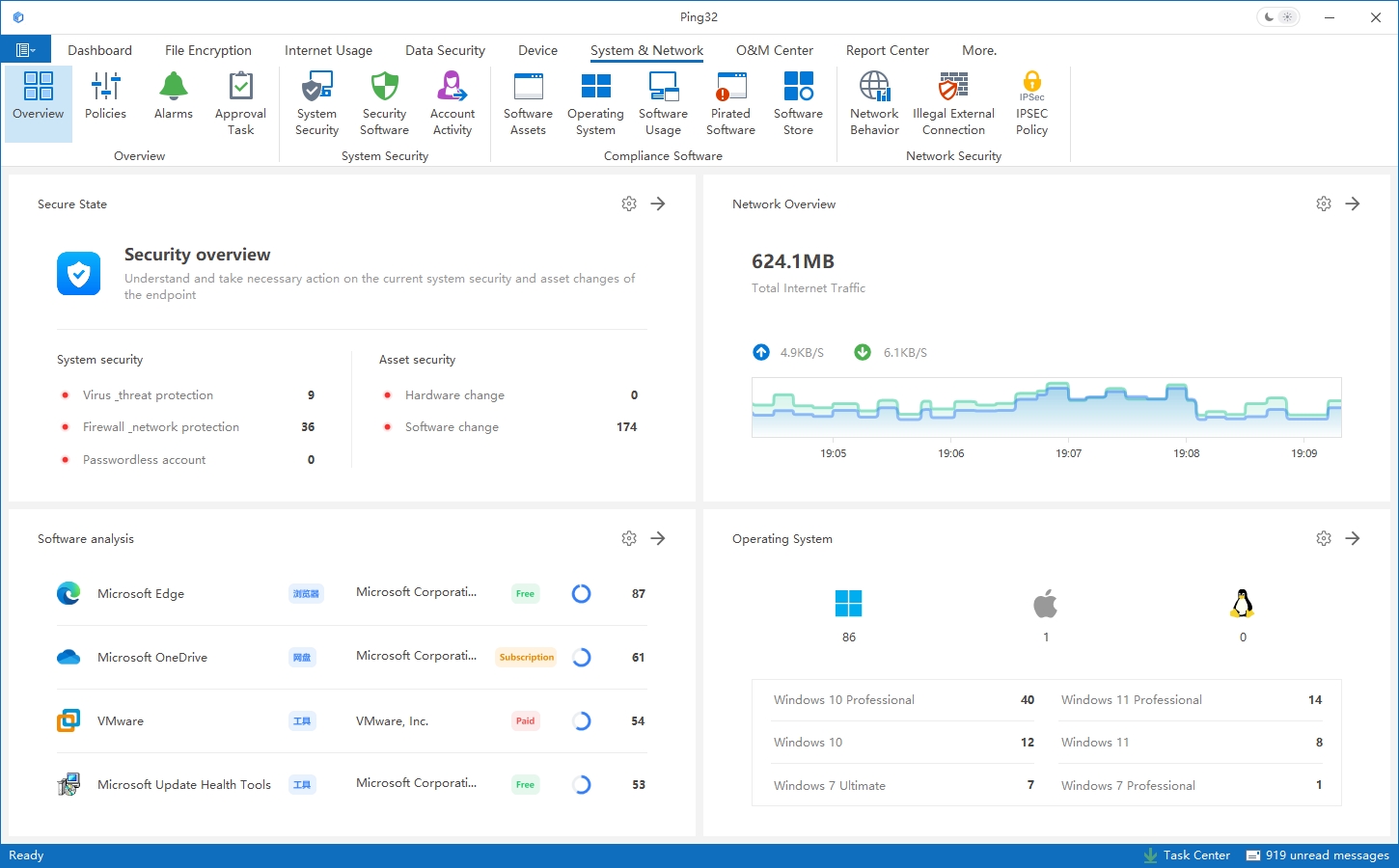
The Ping32 endpoint security management platform deeply integrates an in-process control engine and shifts control logic forward into the execution phase of outbound actions. The core idea is to perform real-time parsing, risk evaluation, and policy enforcement on “outbound actions” without changing user behavior—so security takes effect at the moment business happens, rather than only being discovered during after-the-fact reviews.
Full-Path Coverage: Building a Blind-Spot-Free Endpoint Sensing Network
To govern endpoint outbound risk effectively, the first step is not to “block immediately,” but to make it “visible, distinguishable, and controllable.” Starting from the endpoint, Ping32 decomposes outbound chains along real business workflows and consolidates them into a unified governance view, covering common high-frequency outbound scenarios, including but not limited to:
- Web upload outbound: parsing and governance for browser uploads to third-party websites, online forms, collaboration platforms, ticket/work-order systems, cloud drives/storage, and more.
- Email outbound: attachment sending, recipient domain policies, and approval/block triggers based on sensitive content detection.
- Removable storage: USB copying, exporting, bulk duplication, cross-network “air-gap” transfer, and other high-risk physical outbound behaviors.
- Printing and screenshots (“analog outputs”): auditing print jobs, correlating printed content, and governing screenshot behavior and propagation chains with policy intervention.
- Cross-application transfers: copy/paste, drag-and-drop, “save as,” compression/packaging, format conversion, and other “bypass-style” outbound behaviors with correlated controls.
- Offline and low-connectivity scenarios: policies remain enforceable even when endpoints are offline, with automatic log synchronization once the device reconnects to ensure continuity.
With full-path coverage, enterprises can accomplish outbound visualization, risk grading, policy orchestration, and audit tracing on a single platform—upgrading from “point controls” to “chain-based governance.”
Intelligent Content Awareness (DCI)
Seeing actions alone is not enough. Effective governance must also answer a core question: how sensitive is the file being sent, is it worth stopping, and what response minimizes business disruption?
To achieve this, Ping32 introduces a Data Content Identification (DCI) engine, giving in-process control the ability to “understand” data. Using predefined keyword libraries, regular expressions, file fingerprints, metadata attributes, and structural content features, the system can automatically assess the sensitivity weight of outbound files and label them by risk level.
Based on DCI results, Ping32 can trigger differentiated response mechanisms to achieve “value-based handling” and “scenario-appropriate enforcement”:
- Silent Audit (Audit): unobtrusively record low-risk behavior to ensure business continuity.
- Real-time Alert (Alert): immediately notify administrators when suspected violations occur, shifting risk detection earlier.
- Enforced Block (Block): millisecond-level blocking for non-compliant outbound transfers of high-value core assets, ensuring data does not leave the protected boundary.
- Flexible Approval (Approval): return security decision rights to the business side through online approval workflows, balancing security and efficiency.
This means policies are no longer a blunt “allow/deny” binary. Even within the same channel, different files can receive different treatments based on their value and sensitivity.
Progressive Governance: Making DLP Sustainable
If endpoint outbound governance is enforced with a “one-size-fits-all” approach, it often triggers resistance and workarounds. Ping32 emphasizes a sustainable, progressive rollout method that helps organizations move from visibility to control to optimization—gradually building a stable, long-running DLP framework:
Phase 1: visibility first, then standardization
Start with auditing to map real outbound paths, departmental differences, and high-risk groups, building a baseline profile to support later policy decisions.
Phase 2: graded and scenario-based policies to reduce false positives
Introduce DCI classification and business-context policies, upgrading decisions from “channel-based” control to combined “content + behavior + scenario” governance, reducing misfires and business disruption.
Phase 3: from blocking to collaboration, forming a closed loop
Use alert linkage, approval collaboration, exception handling, and forensic evidence collection to evolve from “one-time interception” to “continuous governance,” embedding security into the business process.
Phase 4: continuous operations and policy iteration
Leverage audit data and incident learnings to continuously optimize rules and sensitivity models, moving from “experience-driven” to “data-driven” governance.
Making Security a “Certainty” in Business Flow
In complex, fast-changing, and highly distributed endpoint environments, in-process control has become the most practical and business-aligned component of modern data leak prevention. By building continuous, full-path outbound sensing on endpoints and combining it with intelligent content identification and dynamic response, Ping32 enables organizations to identify risk in real time, differentiate sensitivity levels, and take policy-driven actions—naturally embedding security requirements into every outbound file transfer.
This is not just an improvement of a single technical capability, but a systemic upgrade to data governance. Instead of relying on after-the-fact tracing or manual constraints, organizations form an executable, verifiable, and sustainable management mechanism during business operations. While preserving data usage efficiency, they gain a stable foundation for compliance audits, risk control, and long-term digital operations—making security an internal capability rather than an added burden.
FAQ (Frequently Asked Questions)
Q1: How is Ping32 in-process control different from a traditional firewall?
A: Firewalls focus on filtering traffic at the network perimeter. Ping32 operates at the endpoint, identifying outbound actions and file content, and making fine-grained decisions based on user, application, and scenario—enabling more business-aligned control and faster loss containment.
Q2: Can uploads over HTTPS-encrypted web pages be effectively identified?
A: Yes. Ping32 can use browser-side capabilities or protocol analysis mechanisms to parse and audit common web upload behavior within HTTPS contexts, and then enforce alerts, approvals, or blocks based on policy.
Q3: Do endpoint outbound control policies still work when devices are offline?
A: Yes. The Ping32 client includes a local policy engine, so it can still execute blocks and audits even when disconnected from the management server, and will automatically sync logs once connectivity is restored.
Q4: Will DCI consume significant endpoint computing resources?
A: No. Ping32 uses optimized, trigger-based scanning and incremental identification, typically performing brief scanning only when an outbound action occurs, so performance impact is minimal.
Q5: How do you prevent employees from bypassing controls by changing file extensions?
A: Ping32 supports file “signature”/fingerprint-based identification that can see through extension spoofing to determine the true file type, and combines this with content identification and policy orchestration to effectively reduce bypass risk.





 Contact


 11 min