




 Contact


 9 min
9 min 
In the early stages of enterprise informatization, data security was largely built around servers, databases, and the network perimeter. As long as core systems were sufficiently secure, data was considered to be under control. However, as business models and ways of working continue to evolve, the primary environments where data is carried and used have shifted significantly. More and more business data no longer stays in centralized systems for long periods; instead, it frequently appears on employees’ endpoints, where it is created, edited, shared, and sent externally in the form of files.
This shift has gradually moved the focus of data security from “whether the system has been breached” to “how data is managed in day-to-day use.” Files are sent via email, uploaded through web browsers to external platforms, or copied to peripherals and removable storage devices (USB). Most of these actions are part of normal business processes, yet they have also become the most common points where data leaks occur. Risk is no longer hidden in complex attack chains—it is distributed across every seemingly legitimate file operation.
For enterprises, this risk pattern is especially real. On the one hand, business increasingly depends on flexible collaboration, making external file sharing almost unavoidable. On the other hand, many organizations lack dedicated security teams and cannot rely on highly complex systems to control every action in real time. How to reduce the uncertainty introduced by external file sharing without significantly increasing management overhead has become a key issue in data security initiatives.
Challenges Brought by Changes in Work Styles and Tools
The growing risk of data leakage is not caused by a single factor, but by the combined effect of multiple shifts in the working environment, mainly reflected in the following:
● Endpoint-centered work has become the norm. Files are the primary carrier of data flows, and large volumes of sensitive information exist as documents created and circulated on personal devices.
● External file-sharing channels have diversified, including email, web uploads, and instant messaging tools.
● Peripherals and removable storage devices remain widely used, making it easy for data to leave controlled environments.
● Endpoints have become the core place where data is handled, but management visibility is often fragmented.
● Customers and partners increasingly require clearer auditability of data handling processes.
Together, these factors lead to one result: even if an enterprise has deployed basic security controls based on the traditional, perimeter-focused approach, it still struggles to clearly answer critical questions such as “Where did the file go?”, “Was it sent externally?”, and “Can we reconstruct what happened afterward?”
Why It’s “Clearly Important” but Still Hard to Implement
Although more and more organizations recognize the importance of Data Loss Prevention (DLP), many face similar challenges when trying to put it into practice:
● Data usage scenarios are complex, making it difficult to quickly determine which files require priority protection.
● File-sharing behaviors are scattered across multiple tools and channels, with no unified view.
● Overly strict controls can disrupt productivity and trigger internal resistance.
● Security deployments are complex and demand significant IT resources and operational capabilities, making them hard to maintain over time.
● After an incident, organizations may only “discover a problem,” but lack complete audit trails for review and explanation.
● Security tools often lack coordination, resulting in fragmented data visibility and an inability to form a continuous management chain.
These issues do not mean organizations don’t value security. Rather, they reflect that traditional security solutions are not well aligned with the “endpoint file circulation” scenario. Enterprises need a DLP path that is closer to everyday work realities and can be implemented step by step.
Ping32’s Approach: Endpoint-Centered, Managed Without Excessive Complexity
Ping32’s understanding of DLP is not to start from a single interception point and attempt to cover every security scenario at once. Instead, it begins with a foundational capability: endpoint management. By bringing file usage and movement into a unified perspective and aligning with real-world internal data paths, Ping32 continuously records file operation behaviors on endpoints. This helps organizations gradually reconstruct how data actually flows in real environments and build an observable, manageable DLP system over time.
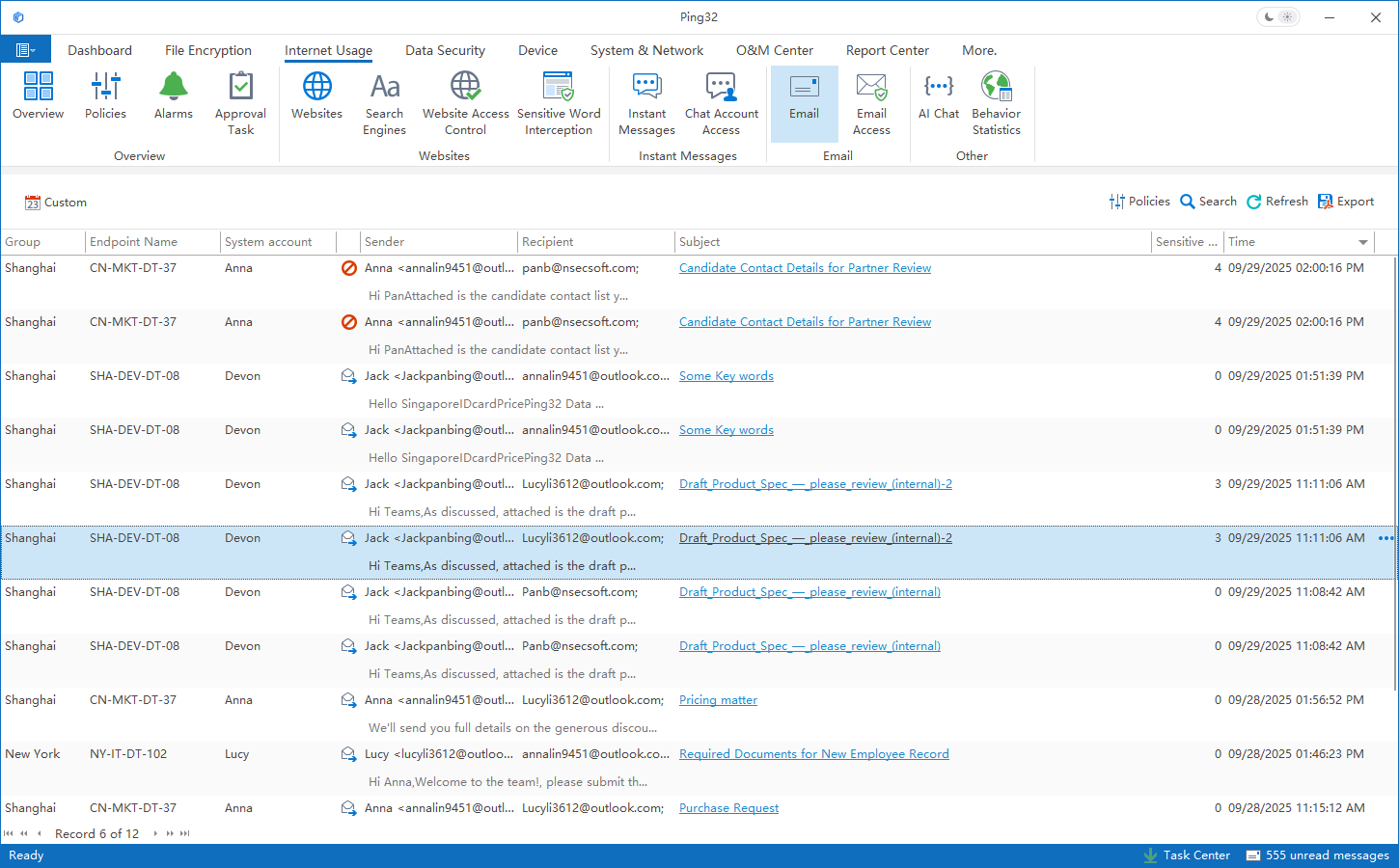
The core value of this approach is “continuity.” Through endpoint management, Ping32 brings file creation, modification, and copying—along with file exports and browser uploads that move files off the endpoint—into one unified view. Whether a file is sent via email, uploaded through a browser, or written to a peripheral/USB device, the related actions can be identified and recorded within the same system. This avoids the complexity of managing different tools and platforms separately, reduces architectural overhead, and provides a stable data foundation for later analysis and decision-making.
On top of that, Ping32 does not require organizations to define complex security policies from the start. Instead, it prioritizes helping organizations “see what’s really happening.” The system focuses not only on whether a specific external transfer is blocked, but on continuously capturing key information throughout the file movement process—so organizations can reconstruct facts and explain “what happened,” not just “whether it was a violation.” After gaining sufficient understanding of their own file-sharing patterns, organizations can then gradually introduce targeted management measures, aligning DLP progress with their operational pace.
Start with Visibility and Auditing, Then Gradually Introduce Policy Controls
For most small and mid-sized businesses, DLP is not something that should be implemented all at once. In practice, Ping32 is better suited to a progressive rollout approach:
● Build visibility: when external file sharing and web uploads occur, see the real situation clearly.
● Strengthen audit trails: establish a stable auditing mechanism with continuous, searchable records of file operations, ensuring key actions can be traced and explained.
● Identify high-risk scenarios: use audit data to locate frequent or abnormal external transfers, providing factual evidence for management decisions.
● Gradually introduce policies: impose constraints on specific scenarios without disrupting business operations, reducing risk over time.
This path emphasizes “understand first, manage second.” It gradually strengthens control over data flows without changing employee habits, avoids productivity loss from premature policy intervention, and helps build organizational consensus around data security—while providing evidence for ongoing decision-making.
The Synergy of File Encryption and External Sharing Governance
Beyond external sharing and audit trails, file encryption provides an additional foundational layer for DLP. With transparent encryption, files can be automatically protected on the endpoint: they work normally in authorized environments, and cannot be directly read in unauthorized ones. This reduces the real-world risk of external sharing at the content level.
When file encryption is used together with external sharing auditing, organizations not only know whether a file was sent out—they can also ensure that the data itself will not become uncontrolled if the environment changes afterward. This combination of “content protection + behavioral visibility” makes the DLP system more complete and better suited for long-term operation.
Practical Value in Typical Scenarios
In R&D-driven organizations, large amounts of source code and technical documents exist as files. With endpoint management and external sharing auditing, organizations can clearly understand how those files circulate, while encryption ensures that even if files are copied, they can only be used in authorized environments.
In design and manufacturing, design drawings frequently move across departments and projects. Ping32’s approach keeps these files auditable and traceable while preserving normal collaboration efficiency.
In finance, HR, and other administrative scenarios, files containing personal information and business data can be governed through unified management and audit trails, helping reduce internal mistakes and compliance risks.
FAQ (Frequently Asked Questions)
Q1: Is Ping32 only suitable for large enterprises?
A: Ping32’s deployment model and management approach are more progressive, making it suitable for organizations that want to build DLP capabilities step by step.
Q2: Will external file-sharing auditing affect employees’ normal work?
A: Auditing is primarily record-based and does not change employees’ daily workflows.
Q3: Does Ping32 require deep integration with existing office systems?
A: Ping32 is primarily endpoint-based and does not rely on modifying specific business systems.
Q4: How long can audit trail data be retained?
A: Retention periods can be configured based on an organization’s compliance and management requirements.
Q5: Does Ping32 support unified management across multiple external sharing channels?
A: Ping32 supports unified identification and recording for common external file-sharing and web upload scenarios.


