In today’s enterprise operations, data has long evolved from a “business support resource” into a true “core production factor.” R&D成果、design drawings, operational data, and customer information—these high-value files are directly tied to an organization’s market competitiveness, regulatory compliance capabilities, and long-term growth potential. However, as digital transformation continues to deepen, the way data is used is undergoing a fundamental shift.
Files are no longer stored centrally within a single system or fixed network. Instead, they move frequently across different endpoints, applications, and users. Remote work, cross-department collaboration, and external partnerships have become the norm, placing data in a state of continuous movement by default. While this transformation improves operational efficiency, it also blurs the traditional security boundaries around enterprise data.
A large number of security incidents show that data breaches do not always originate from external attacks. More often, they stem from inadequate internal controls, uncontrolled file circulation, or human error. Once critical data is obtained illegally, the consequences extend beyond direct financial losses to include compliance risks and damage to brand reputation. How to maintain business flexibility while firmly protecting the final line of data security has become a long-term challenge that enterprises must address.
From “Leak Prevention” to “Secure Even After Leakage”: File Encryption Becomes Essential
In the past, enterprises primarily relied on network isolation, access control, and permission management to protect data. These measures were effective in environments with clear boundaries and relatively static conditions. However, in today’s highly dynamic business environments, perimeter-centric security models are facing increasing limitations.
On one hand, external file sharing is almost unavoidable in real-world operations—whether for partner collaboration, internal coordination, or ad-hoc communication. Simply “prohibiting file sharing” is not realistic. On the other hand, once a file leaves its original system or network, traditional security controls often stop working, leaving the file completely unmanaged in external environments.
As a result, more enterprises are recognizing that perimeter defenses alone are insufficient for long-term data security. Truly reliable protection must follow the data itself and remain effective throughout the entire file lifecycle. File encryption has therefore emerged as a foundational capability within modern enterprise data security architectures.
Unlike traditional approaches, file encryption does not revolve around “behavior” or “environment,” but acts directly on the data itself. By tightly binding control mechanisms to the file content, encrypted files no longer depend on specific systems or networks and can remain under control in any scenario.
This shift in security philosophy allows enterprises to retain control over the usage scope and risk boundaries of critical data, even in complex and changing business contexts. Even if files are copied, forwarded, or stored on unmanaged media, their contents cannot be read or used without proper authorization. Ping32’s file encryption is designed around this concept—not merely to “add another lock,” but to help enterprises build a long-term, stable, and practical data protection mechanism.
What Is Ping32 File Encryption: A File-Centric Continuous Protection Mechanism
Ping32 File Encryption is a transparent encryption system implemented at the endpoint level, emphasizing “security without disrupting business.” Its core objective is to provide long-term, stable protection for sensitive files without changing user workflows or habits.
By performing encryption and decryption at the operating system level, the system ensures that files remain under control throughout their entire lifecycle—from creation and editing to saving, copying, and circulation.
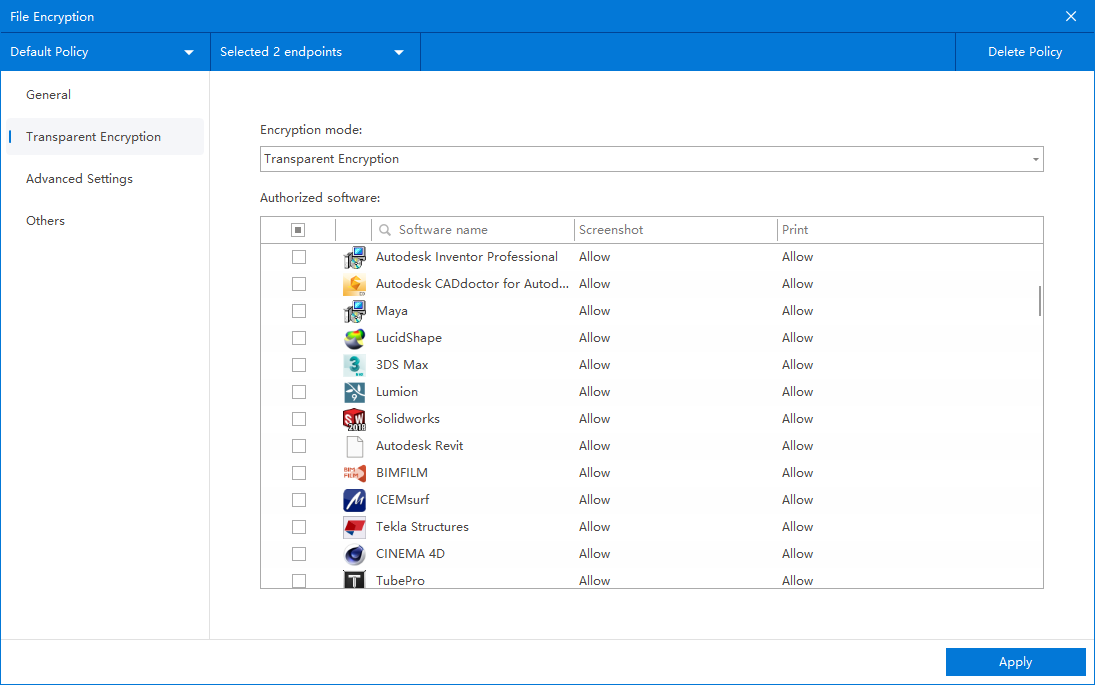
For authorized users, the experience of using encrypted files is virtually identical to that of ordinary files. No additional decryption steps are required, and daily productivity is unaffected. In unauthorized environments, however, encrypted files cannot be opened normally, effectively preventing data misuse.
This “transparent internally, controlled externally” design transforms file encryption from an added burden into a foundational capability, balancing security requirements with enterprise needs for efficiency and usability.
Three Core Elements of Transparent Encryption: Stability Comes First
In enterprise-grade encryption products, security is the baseline, but stability determines whether a solution is truly usable and sustainable over time. Ping32 places “stability” at the center of its design philosophy, ensuring business continuity from underlying architecture to real-world usage.
1. Kernel-Level Driver Architecture for System-Level Stability
Ping32 integrates encryption logic directly into the operating system’s file I/O processes, avoiding compatibility issues commonly associated with application-layer encryption. This ensures that files are not corrupted, lost, or abnormally altered while encrypted.
Because encryption and decryption occur at the system level, users are largely unaware of the encryption process, minimizing any impact on daily work.
2. Deep Compatibility with Mainstream Office and Productivity Tools
Ping32 is deeply compatible with widely used enterprise applications such as Office, WPS, AutoCAD, and SolidWorks. Whether editing documents, designing drawings, or frequently saving complex files, all operations function normally in encrypted states.
This high level of compatibility ensures that encryption can be truly deployed in real business environments rather than remaining “secure but impractical.”
3. Long-Term Stable Residency Across Multiple Operating System Environments
Ping32’s encryption kernel can reside stably within the operating system for extended periods and supports multiple versions of Windows. Even in complex endpoint environments and large-scale deployments, it maintains stable operation without blue screens, system crashes, or driver conflicts—providing reliable support for continuous enterprise operations.
A Proven Encryption Core That Forms the Foundation of File Security
Ping32’s transparent file encryption core is a next-generation, enterprise-grade encryption engine independently developed based on years of accumulated data security expertise. It combines technologies such as hardware virtualization, kernel-level file system isolation, and micro-filtering to establish a highly stable file protection mechanism at the operating system level.
Through deep integration with critical file system paths, Ping32 performs real-time encryption and automatic decryption at key stages such as file creation, editing, copying, and saving. Files remain usable in authorized environments and automatically become inaccessible in unauthorized ones. This design makes encryption an inherent attribute of the file itself rather than an external restriction.
Today, Ping32’s encryption system runs stably over long periods across thousands of enterprises and millions of endpoints, spanning multiple industries and business scenarios—fully validating its reliability and sustainability in real-world environments.
The Core Value of File Encryption for Enterprises
The core value of file encryption ultimately lies in its ability to continuously protect critical business scenarios.
Through transparent file encryption, enterprises can reduce the real-world impact of data leaks at the source. Even if files are accidentally shared externally, copied to insecure environments, or lose control during cross-department circulation, unauthorized users still cannot access the content—effectively limiting risk exposure.
● In R&D-driven enterprises, source code and technical documents can only be used on authorized endpoints and by authorized users, keeping core technologies under control throughout their lifecycle.
● In design and manufacturing industries, design drawings remain encrypted during cross-project and cross-department collaboration, preserving collaboration efficiency while preventing unauthorized copying or removal.
● In finance and HR scenarios, encryption provides baseline protection for files containing sensitive personal information and operational data, significantly reducing internal leakage risks.
From a compliance perspective, file encryption also provides critical technical support for fulfilling data protection obligations, enabling enterprises to clearly demonstrate that reasonable and effective safeguards are in place during audits and regulatory reviews. More importantly, Ping32 File Encryption ensures security without disrupting business processes or degrading user experience—making security a foundational capability that supports long-term, stable operations rather than an added burden.
Conclusion: Protecting Core Enterprise Data Assets with Stable Encryption
In enterprise data security strategies, file encryption is never an isolated capability.
Ping32 Transparent File Encryption works in synergy with external file control, data leak prevention, and breach tracking and analysis through a combined approach of “encryption + control + analysis.” This not only ensures that data content remains under control, but also helps enterprises continuously understand how files are used and circulated in real environments.
Such coordinated capabilities enable enterprises to gradually build a data security governance framework that spans the entire data lifecycle, moving away from fragmented and siloed protection methods. As data value continues to rise and business environments grow more complex, truly reliable security must withstand long-term operation and high-intensity usage.
Ping32 Transparent File Encryption takes stability as its core design principle and practical deployment as its goal—establishing a trusted data security foundation for enterprises, continuously safeguarding critical data assets, and supporting steady, sustainable business growth.
Frequently Asked Questions (FAQ)
Q1: Does Ping32 File Encryption affect normal file opening and editing?
A1: In authorized endpoint and user environments, encrypted files can be opened, edited, and saved normally, just like ordinary files. Encryption and decryption are handled automatically at the system level.
Q2: Can encrypted files be opened if copied to another device?
A2: No. Encrypted files cannot be opened in unauthorized devices or environments. Copying a file does not remove its encrypted state.
Q3: Does Ping32 File Encryption support common office and design software?
A3: Yes. Ping32 is compatible with a wide range of mainstream office and productivity tools. Encrypted files function normally in these applications without affecting existing workflows.
Q4: Does file encryption impact system performance or stability?
A4: The encryption mechanism is based on kernel-level drivers and has been validated through long-term, large-scale deployments. Under normal usage, it does not have a noticeable impact on system stability.
Q5: Is Ping32 File Encryption suitable for long-term operation in enterprise endpoint environments?
A5: Yes. Ping32’s encryption kernel is designed for long-term residency within operating systems and is well suited for large-scale endpoint deployments and continuous enterprise use.





 Contact


 11 min