




 Contact


 11 min
As digital work continues to deepen across enterprises, electronic files now carry the vast majority of critical business information—from R&D drawings and source code to customer lists, contracts and agreements, as well as financial statements and HR records. Files are both the “common language” of collaboration and the “practical carrier” of data in motion. Once a leak occurs, the impact often goes far beyond direct financial loss: it may trigger trade secret exposure, erosion of competitive advantage, brand reputation damage, and follow-on legal and compliance liabilities. More importantly, in real-world scenarios, file leakage does not always rely on sophisticated attack chains. Instead, it is more often caused by frequent, low-barrier everyday operations—and once it happens, it becomes difficult to trace and contain.
From a root-cause perspective, high-incidence risk points typically concentrate in five areas: external sharing, copying, personnel changes, endpoint loss of control, and legacy exposure. Examples include employees mistakenly sending files via email or instant messaging to unrelated individuals or groups; files being copied to USB drives, personal computers, or personal cloud storage and slipping out of corporate control; departing or reassigned staff taking project materials or long-accumulated document assets; lost devices or compromised accounts leading to bulk exports and secondary dissemination; and large volumes of historical plaintext files stored long-term on servers or endpoints without any protection policy. Ultimately, these issues point to the same fact: systems may be secure, but if files themselves cannot remain controlled after leaving the system, data will still fail at the “last mile.”
The Boundary of Traditional Security
Many enterprises build information security around network perimeters and system access controls—firewalls, intrusion detection, anti-malware, and privilege management. These capabilities are essential for resisting external intrusion, but they primarily answer “who can enter the system” and “who can access resources,” not “whether a file remains controllable after it is downloaded, copied, transferred, or shared externally.” Once a file is opened, downloaded, or copied by an authorized user, control typically starts to degrade the moment the file crosses the system boundary—creating a gap where systems are controlled, but files outside the system are not.
Operationally, this gap shows up as: difficulty enforcing strong constraints on whether a specific file may be shared, where it may be sent, and to whom; inability to ensure that files remain manageable after leaving business systems or the internal network; limited ability to continuously apply policy to copying, re-storage, and secondary distribution; and challenges in truly enforcing data classification, privacy, and compliance requirements at the file level. Therefore, file-level security must return to the file itself. The core value of file encryption is extending control from network and system boundaries to the entire lifecycle of file storage, transfer, and use—so policy remains effective across any location, medium, or path.
Why Is File Encryption “Hard to Operationalize”?
File encryption is not a single “install-and-done” capability—it is a long-running security mechanism. Many encryption approaches work in test environments but face resistance in real business operations. The issue is often not “whether encryption is possible,” but whether it disrupts workflows, covers diverse scenarios, and brings legacy and external files into the same governance framework. If employees must perform frequent manual steps, repeatedly enter passphrases, or change long-established usage habits, encryption becomes a productivity burden and gets bypassed. If only a single policy exists, it is difficult to satisfy both strong protection needs in R&D and high-collaboration needs in business-facing departments. If legacy plaintext and external files cannot be governed, enterprises will be left with long-term security blind spots “outside” the encryption system.
The three most common challenges in deployment can be summarized as:
-
Security vs. efficiency trade-off: strong protection should not come at the expense of everyday collaboration
-
Scenario differentiation: R&D, administration, marketing, and executives use files very differently
-
Legacy + incremental governance: historical plaintext and daily inflows of external files must be unified under one control plane
Ping32’s Design Philosophy
Ping32 does not advocate using one policy to cover every department. Instead, it emphasizes a scenario-based approach. Enterprises can choose different encryption modes—and deploy them in combination—based on key questions such as where files are created, how they flow, who uses them, whether external sharing is required, and how compliance requirements should be enforced. This enables layered, segmented, and scenario-specific protection: enforcing strong, non-bypassable controls for high-value data while preserving necessary flexibility for high-collaboration departments, and integrating sensitive content identification, legacy file remediation, and external file governance into a single closed loop.
Five File Encryption Modes
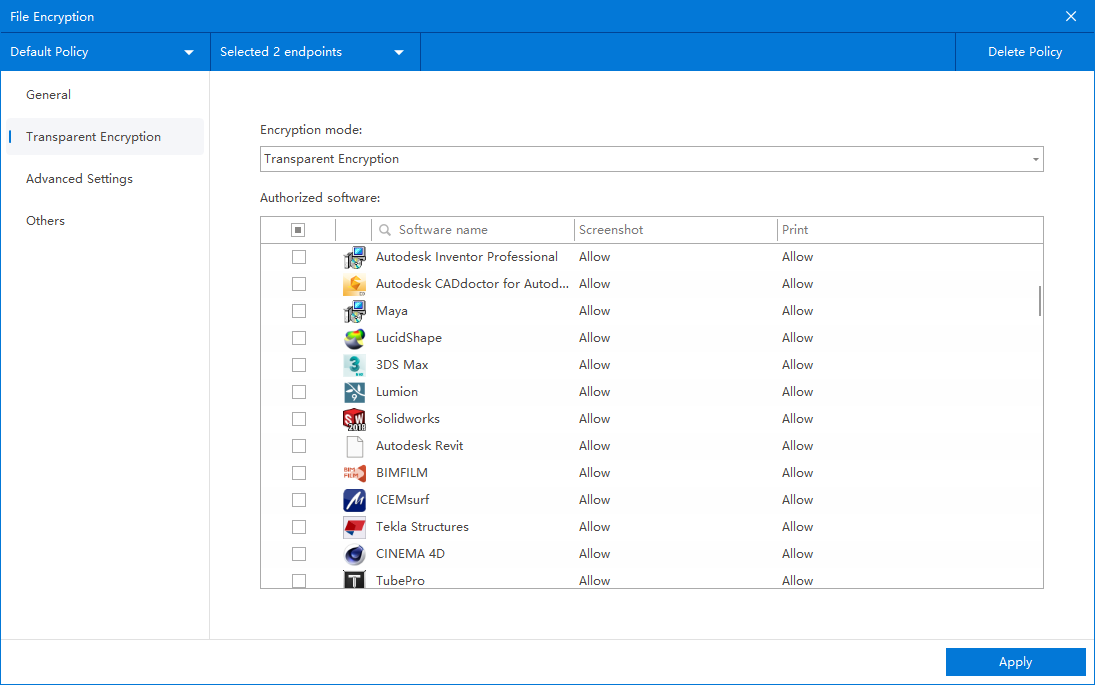
1) Transparent Encryption: Mandatory, low-friction protection for core data
Transparent encryption is suited for high-sensitivity, high-value environments such as R&D, design, and finance. Ping32 leverages OS-level mechanisms to automatically encrypt files before they are written to disk, and automatically decrypt them when accessed in an authorized environment. For employees, creating, opening, editing, and saving feels the same as ordinary files. For security teams, files are always stored as ciphertext and become unusable outside authorized environments—reducing leakage risks at the source, including copying, device loss, and illicit acquisition.
Use cases: source code/technical documentation, design drawings/prototypes, financial audit materials, executive strategy and HR records
Value: mandatory and hard to bypass, low user friction, encryption travels with the file and is unusable outside scope
2) Semi-Transparent Encryption: Preserve collaboration flexibility within a unified policy
In administrative and marketing departments where collaboration is frequent, not all files share the same sensitivity. Semi-transparent encryption allows enterprises, within a unified policy framework, to preserve limited user choice—deciding whether to encrypt when creating a file or in specific business scenarios—so that low-sensitivity files are not “over-protected,” which can increase communication and delivery costs. It provides a more sustainable balance between security baselines and collaboration efficiency.
Use cases: daily office work, administrative approvals, marketing plans and internal reporting, executive review and circulation
Value: higher adoption, reduced deployment friction, avoids productivity loss from one-size-fits-all enforcement
3) Content-Detection-Based Encryption: Protect only what truly matters
Sensitive information is often scattered across many “ordinary-looking” files—for example, customer data in contracts or spreadsheets, employee data in HR documents, and technical keywords buried in design explanations or delivery documentation. Ping32 links sensitive content detection with encryption: files are analyzed in real time or on a schedule, and matching rules automatically trigger encryption. Enterprises can define business-specific rules (ID numbers, bank card/account numbers, phone numbers, project code names, core technical keywords, regular expressions, etc.) to enable more precise, auditable, and explainable classification and tiered protection.
Use cases: personal information/privacy protection, HR payroll, core algorithm materials, highly regulated industries requiring classification and tiering
Value: precise encryption reduces blanket protection, lowers manual identification cost, supports compliance and audit execution
4) Full-Scope Encryption/Decryption: Systematic governance for legacy plaintext files
Before an encryption system goes live, enterprises typically accumulate large volumes of legacy plaintext files spread across endpoints, file servers, and shared directories—many of them highly sensitive but long unprotected. Full-scope encryption/decryption brings specified ranges of files into the encryption framework through batch scanning and automated processing. This is ideal for initial rollouts or compliance remediation, helping enterprises quickly eliminate historical blind spots and establish a consistent data protection baseline.
Use cases: initial deployment, compliance/audit remediation, data migration/system transitions, pre-exit data handling
Value: quickly closes legacy gaps, reduces manual omissions, establishes a foundation for closed-loop governance
5) File Discovery / New File Encryption: External files become controlled the moment they land
In modern workplaces, external files enter through many channels: email attachments, instant messaging transfers, browser downloads, USB copying, and more. These files come from mixed sources with unclear destinations—and once they land, they can be redistributed, creating new leakage paths. Ping32 supports identifying newly ingested files and automatically applying encryption the moment they first land in the enterprise environment. This enables “ingress governance” without requiring extra user steps.
Use cases: supplier/procurement documents, sales/customer materials, marketing/industry reports, roles with frequent internal-external exchanges
Value: reduces external-file ingress risk, covers multi-channel landing scenarios, does not disrupt existing work habits
Multi-Mode Combination
File encryption is not a one-time project—it is a capability that must evolve as organizations scale, collaboration patterns change, and compliance requirements increase. Ping32 supports combining multiple encryption modes by org structure, role, data type, and process node: transparent encryption as a baseline for core data; semi-transparent strategies to balance efficiency in collaboration-heavy departments; content-based encryption for compliance-sensitive data; and batch remediation plus landing encryption to close gaps for legacy and external files. Enterprises can iteratively improve policies without overturning existing systems, keeping security capabilities aligned with business growth.
Conclusion
The goal of file encryption is not to lock everything down, but to ensure key data remains controllable, traceable, and governable in any situation—without turning security into a business burden. With a multi-scenario, multi-mode file encryption framework, Ping32 helps enterprises upgrade file-level security from passive defense to proactive governance, providing a practical, deployable security foundation for long-term resilient operations.
FAQ
Q1: Will transparent encryption affect user experience?
A: In authorized environments, files are automatically decrypted, so day-to-day opening, editing, and saving workflows remain essentially unchanged. The focus is “low-friction mandatory protection.”
Q2: Why not enforce mandatory encryption for all files uniformly?
A: Different departments have very different collaboration and external-sharing needs. A single mandatory policy often causes productivity loss and deployment resistance. Scenario-based layered governance is more practical.
Q3: We have many legacy plaintext files—how can we close the gap quickly?
A: Full-scope encryption/decryption can batch-govern specified ranges during initial rollout or compliance remediation, systematically eliminating legacy blind spots.
Q4: Can externally received files automatically enter the encryption framework?
A: Yes. With file discovery/new file encryption, external files can be automatically encrypted upon first landing based on rules—without additional user operations.
Q5: What types of organizations benefit most from content-detection-based encryption?
A: Organizations with dispersed sensitive information, high manual identification costs, or clear compliance obligations—especially those handling personal data, customer information, and core technical materials.


