




 Contact


 7 min
7 min 
For a long time, information security was widely regarded as a priority only for large enterprises, financial institutions, and government or public-sector organizations. Many small and medium-sized enterprises (SMEs) believed that their scale was limited, their data held little value, or that “no one would deliberately target us,” leading to relatively low investment in security initiatives.
However, with the rapid evolution of working models, the widespread adoption of remote collaboration, and the extensive use of cloud services, instant messaging tools, and AI applications, the boundaries of enterprise data are being continuously eroded.
In this environment, data breaches no longer rely on sophisticated attack techniques. A single employee mistake, an unregulated external data transfer, or even an unconscious copy-and-paste action can result in severe and irreversible consequences. For SMEs, data loss prevention (DLP) is no longer an “optional upgrade,” but a fundamental requirement for business continuity and competitiveness.
SMEs Are Entering a Period of Concentrated Data Risk Exposure
Changes in the way people work are a major driver behind the rapid increase in data risks. Remote work, mobile work, and hybrid work models have become the norm. Employees are no longer confined to fixed internal networks, but instead rely on laptops, remote desktops, VPNs, cloud storage, and instant messaging tools to handle tasks anytime and anywhere.
While this flexible and efficient collaboration model significantly improves productivity, it also disperses data flows and makes it difficult for enterprises to rely on traditional “network perimeter” controls to manage data effectively.
At the same time, the growing diversity of tools and platforms further amplifies risk. Enterprise software usage has expanded from traditional office suites to a wide range of SaaS systems, cloud platforms, collaboration tools, and rapidly adopted AI applications.
A large proportion of work activities are now completed through web browsers, with data constantly moving through web access, API calls, and file uploads and downloads. Without continuous visibility and management mechanisms, data can easily leave the organization’s control without being noticed.
In addition, changes in the external environment and compliance requirements are prompting SMEs to reassess their data security capabilities. More and more customers are paying attention to whether their suppliers have basic data protection and endpoint management capabilities. Even SMEs may be asked during project collaborations, customer audits, or assessments whether data loss prevention measures are in place.
This means that data security is no longer just an internal management issue, but a critical factor that directly affects business cooperation and customer trust.
Real-World Challenges: Acknowledged as Important, Yet Difficult to Start
Although an increasing number of SMEs recognize the importance of data loss prevention, many still face significant obstacles when it comes to real-world implementation. These challenges are not caused by a single factor, but by a combination of cost constraints, operational complexity, limited staffing, and difficulties in selecting suitable solutions.
Common challenges include:
-
Traditional DLP solutions are primarily designed for large enterprises, with complex deployments, long implementation cycles, and high costs of operation and maintenance
-
Fast-paced business environments and lean teams mean overly restrictive security controls can reduce efficiency and trigger employee resistance
-
A lack of clear understanding of internal data risks, making it difficult to identify which behaviors and scenarios pose the greatest threats
-
An overcrowded market with complex feature sets, making it hard to determine which capabilities truly address high-frequency risks
-
Uncertainty around scalability and long-term costs as the business grows
Taken together, these issues leave many SMEs stuck in a wait-and-see state—aware of the risks, yet hesitant to move forward.
The Design Philosophy of Ping32: Comprehensive Control Without Added Complexity
It is precisely in this context that Ping32 has defined its core design philosophy: delivering comprehensive data protection while maintaining simplicity and real-world usability. Ping32 focuses not on how complex the technology is, but on whether SMEs can truly adopt, use, and sustain data loss prevention capabilities in their everyday business environments.
Unlike traditional DLP solutions built for large enterprises, Ping32 does not attempt to cover every theoretical security scenario. Instead, it starts with the most common and highest-risk data movement paths for SMEs—such as external file sharing, instant messaging, web uploads, and copying to external devices—and addresses them from the endpoint level. This approach helps organizations establish a clear, controllable, and sustainable data loss prevention framework.
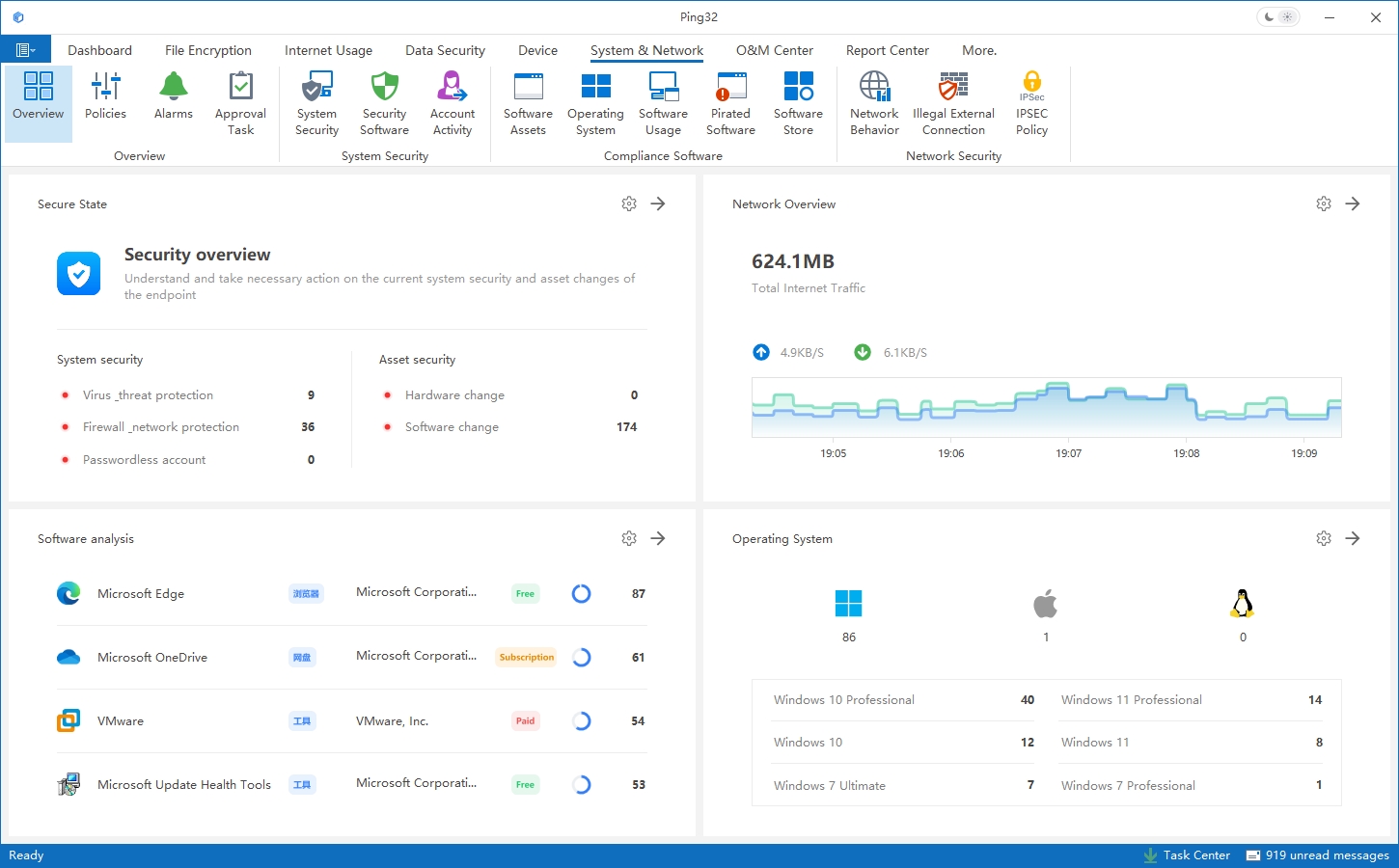
In practical use, Ping32 emphasizes “out-of-the-box deployment” and “non-intrusive management.” Deployment is flexible and does not require complex network reconfiguration or additional hardware investment, allowing organizations to go live quickly through online deployment. During daily operations, the system minimizes disruption to employee workflows, avoiding excessive pop-ups or complicated procedures that could negatively impact productivity. Security becomes a natural part of everyday work.
From a management perspective, Ping32 promotes a gradual, step-by-step approach. Organizations can begin with behavior visibility and auditing to understand how data flows, which actions occur most frequently, and where potential risks lie. Based on these insights, they can progressively introduce policy controls and risk alerts, achieving a smooth transition from “seeing risks” to “controlling risks.”
The Right-Fit Solution Is the Only Sustainable Security Solution
For SMEs, data loss prevention does not have to mean high barriers, high complexity, or high costs. A truly effective security solution should provide comprehensive coverage while minimizing deployment and operational burdens, allowing security capabilities to integrate naturally into business processes and become part of standardized management rather than an additional burden.
Ping32 offers a data loss prevention journey that aligns with the real needs of SMEs: starting with risk visibility, gradually moving toward behavior control, and continuously optimizing management strategies through real-world use.
Without disrupting business operations, Ping32 helps organizations build a stable and sustainable data security foundation—transforming data loss prevention from a conceptual concern into a long-term, executable management capability.
FAQ | Common Questions About Data Loss Prevention for SMEs
Q1: Is Ping32 suitable for SMEs without a dedicated security team?
Yes. Ping32 is designed for business managers and IT administrators, with a low configuration and learning threshold, enabling quick adoption even without specialized security expertise.
Q2: Does deploying Ping32 require changes to existing networks or additional hardware?
In most cases, no. Ping32 supports flexible deployment models and can be implemented without complex network modifications.
Q3: Can we start with monitoring and auditing, and then gradually strengthen controls?
Yes. Ping32 supports a phased approach, allowing organizations to establish risk visibility first and then enable control policies as needed.
Q4: Will Ping32 impact employees’ daily productivity?
No. Ping32 follows a “non-intrusive management” principle, continuously managing data flows without disrupting normal work processes.
Q5: Can the system scale smoothly as the company grows?
Yes. Ping32 supports incremental expansion on the existing architecture, avoiding the need to rebuild from scratch and making it suitable for long-term use.


