Protecting manufacturing drawings is not the same as simply encrypting files. Engineering drawings move through design, revision, approval, procurement, outsourcing, production, service, and archive workflows, often across CAD formats, PDFs, Office files, images, and industry-specific file types. The hard part is not turning a file into ciphertext. The hard part is allowing authorized engineers to work normally, preventing unauthorized reuse, and keeping external sharing, offline use, approval, and audit under one coherent control model.
In manufacturing environments, drawing leakage is often caused not by a single attack but by normal collaboration activities that drift out of control: supplier sharing, temporary decryption, offline copies during travel, exposed historical files in shared paths, and uncontrolled reuse after external delivery. If a solution focuses only on encryption algorithms and does not cover trusted processes, external release controls, recall capability, offline limits, and audit evidence, it will not fully protect engineering assets.
Why drawing protection is more complex than ordinary document protection
Drawings carry high-value information such as structures, dimensions, tolerances, materials, and process details. They also move across longer workflows than standard office documents and rely on specialized design, viewing, and conversion tools. That makes process trust and business compatibility central to any usable protection model.
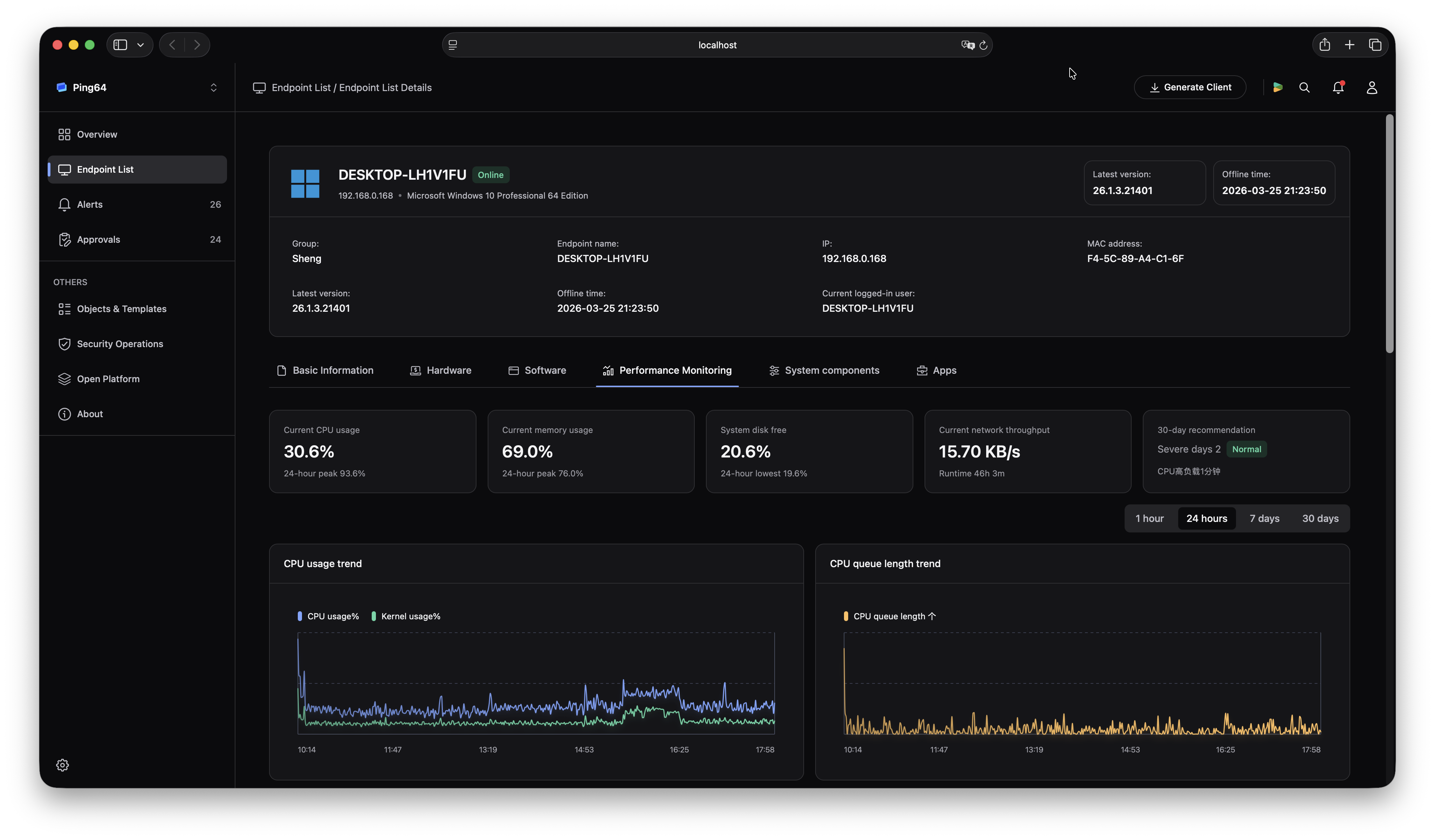
How Ping64 document encryption can be applied
First, administrators can enable encryption capability on target endpoints from Start → Endpoints and confirm that the encryption service is running by checking sc query WinNtDes and verifying that STATE is RUNNING. This establishes the runtime foundation for transparent encryption and later policy controls.
Second, administrators can define trusted software behavior through Document Encryption → Authorized Software. Importing the authorized software library helps the system determine which processes are allowed to handle which file types as legitimate business behavior. In manufacturing, this is critical for CAD tools, viewers, converters, and custom engineering applications, because poor process classification can lead to business disruption or policy bypass.
Third, controlled external sharing can be configured through Document Encryption → Policy → Advanced Settings → File External Distribution. In high-value drawing scenarios, the safer model is usually approval-based external distribution, with approval templates and validity periods configured before a release package can be generated. This converts drawing release from a user-side judgment into a governed workflow.
On the endpoint side, users can generate controlled release packages from encrypted files through Document Security → Create File External Package, or submit Request File External Package through the tray workflow. The platform supports .nsp external files and packaged exe releases depending on the delivery scenario.
Fourth, if online validation was enabled when the release package was created, administrators can later recall it through Document Encryption → Approval Tasks → File External Distribution. This is especially important when a supplier relationship changes, a file is sent by mistake, or project scope changes after delivery.
Fifth, offline exposure can be limited through Document Encryption → Policy → Advanced Settings → Offline Policy, where administrators can allow encrypted files to be opened only within a defined safe time window. Transparent encryption and decryption activity can then be reviewed in Document Encryption → Transparent Encryption/Decryption, which supports audit validation and post-incident analysis.
Why this matters in manufacturing
Manufacturing drawing protection fails when collaboration remains possible but control disappears once the file leaves the organization. Ping64’s value is not one isolated feature. It is the ability to connect endpoint enforcement, trusted process recognition, approval-based release, recall, offline timing, and auditability into one workable governance loop.
FAQ
Q1: Why can’t manufacturing drawing protection reuse ordinary Office file policies directly?
Because engineering drawings depend on specialized tools and more complex collaboration paths. Without trusted process handling, policy compatibility problems are much more likely.
Q2: Why is approval-based external release usually better than free external release?
Because drawing distribution often involves core intellectual property. Approval-based release adds responsibility, time limits, and workflow evidence before the file leaves the organization.
Q3: Does offline control make field work harder?
Not necessarily. If the safe offline time is configured properly, engineers can continue working when needed while the organization avoids unlimited offline access to sensitive drawings.





 Contact


 5 min
5 min